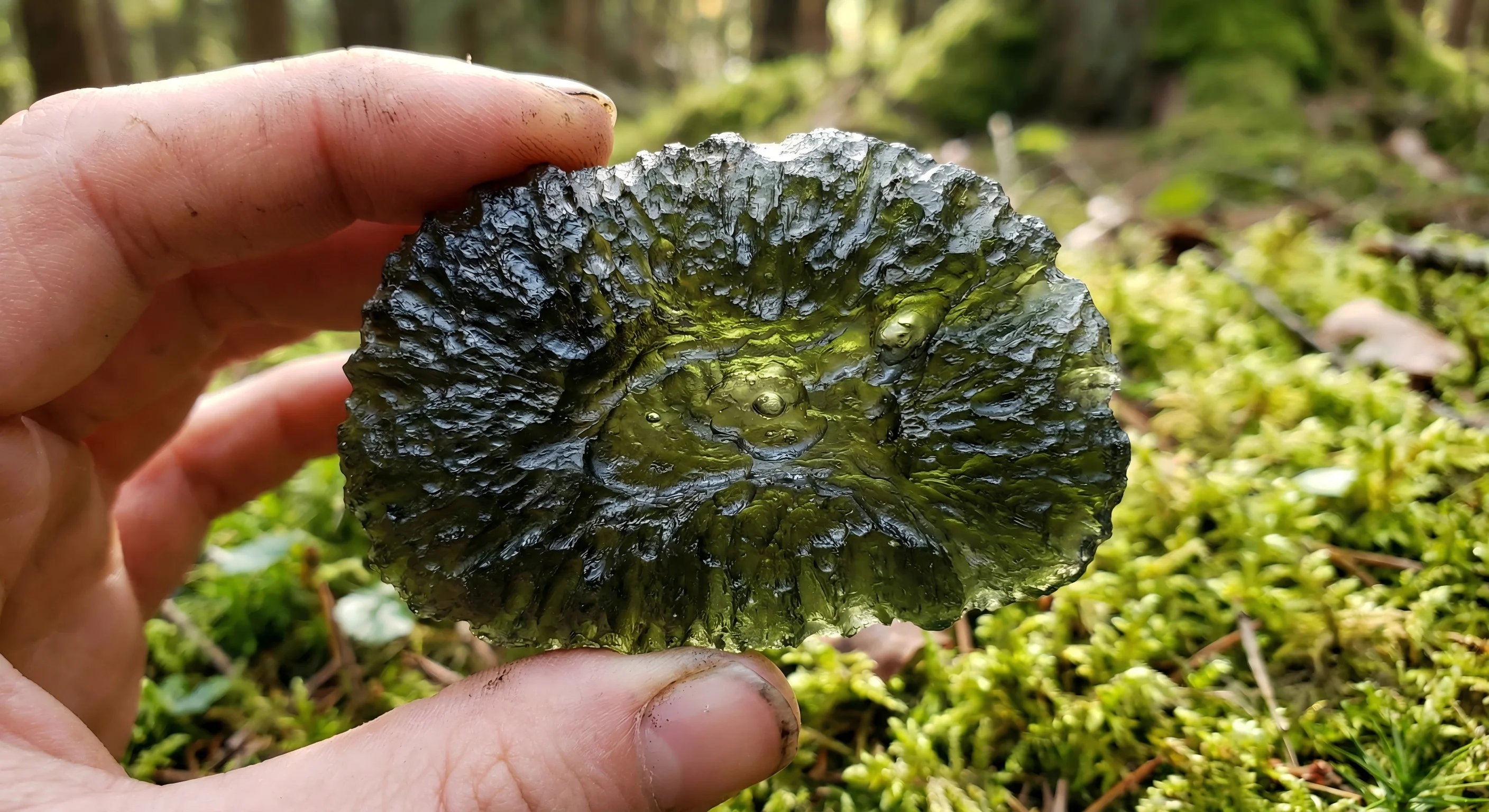
I spent the better part of three years destroying cheap industrial glass trying to artificially replicate tektite birefringence. You cannot easily simulate 14 million years of geological stress in a laboratory furnace. True Angel Chimes possess a unique optical property directly tied to their acoustic resonance: anomalous birefringence. If you place a standard, well-annealed piece of glass or a common moldavite between two crossed polarizing filters, it remains uniformly dark as light is blocked. Place an Angel Chime under the exact same setup, and vivid, rainbow-colored hyperbolic lines emerge, intersecting at sharp, acute angles. These are not inclusions; they are the physical manifestation of the invisible tension vectors.
Let us address a common, frustrating myth in the community: stop trying to diagnose these stones using cheap polarized sunglasses held up to an LED flashlight. I have witnessed collectors severely misdiagnose, and subsequently overpay for, perfectly common specimens because of edge-light leakage and poor filter alignment. You must use a proper gemological polariscope with a dedicated light source. The ugly truth about these magnificent stress lines? They are essentially microscopic fault lines. When you strike the stone, the acoustic wave travels rapidly along these highly tense, rigid pathways without dampening, creating the prolonged chime. However, this exact same rigid pathway is where the stone will inevitably split if mishandled.
Under a 10x loupe, we frequently observe 'Schlieren' lines—wavy, syrup-like flow structures of lechatelierite (nearly pure silica glass) embedded within the moldavite matrix. Because lechatelierite has a significantly different thermal expansion coefficient than the surrounding green glass, it creates intense, localized microscopic tension fields around itself. If an Angel Chime has a surprisingly low, resonant pitch, it generally indicates a thicker, more uniformly stressed overall structure. A high, piercing, sharp pitch means extreme, localized tension—beautiful to the ear, but terrifying to handle. The paradox of the collector is constant: you are forced to balance the desire to physically experience the acoustic anomaly against the absolute necessity of preserving the structural integrity of the artifact.