Moldavite Zen
home / moldavite verification value / The Glass Replica Library: Educational Guide to Fake Moldavite Types

The Glass Replica Library: An Educational Guide to Fake Moldavite Types

The physical study of impact tektites presents a rigorous intersection of geology and engineering. In 2026, categorizing Fake Moldavite Types requires abandoning rudimentary scratch tests for systematic gemological frameworks.

The Surface Tension

When you handle a translucent green specimen, an uninterrupted, shiny surface immediately flags a modern manufacturing origin. Natural tektites endure immense atmospheric friction, resulting in fundamentally matte exteriors.

Engineered Origins

Historically documented in trade journals as Chinese moldavite fakes, these man-made glass specimens are technically impressive. They represent highly advanced silicate engineering rather than cheap novelties.

Chemical Emulation

Commercial artisans routinely employ acid treated glass—specifically hydrofluoric washes—to artificially etch the surface. This technique emulates natural aerodynamic pitting, creating deeply textured molded copies designed to bypass casual visual inspection.

🔬 The Veteran's Reality Check: Handling Raw Silicates

I have spent over a decade handling rough silicates, and the first lesson you learn is sensory, not visual. Stop looking at the color and start listening to the material. When you drop a natural tektite onto a wooden sorting tray, it produces a distinct, resonant "clink"—a slightly higher frequency than standard bottle glass due to its incredibly low water content and high silica purity. Synthetic replicas, heavily doped with fluxes like sodium carbonate to lower the melting temperature in commercial kilns, yield a duller, flatter acoustic response.

The ugly truth about authenticating these specimens is that textbook examples rarely appear in the field. Natural moldavite from the Chlum or Besednice localities is frequently covered in stubborn, iron-rich Moravian clay. Cleaning it requires ultrasonic baths and meticulous picking with bamboo skewers to avoid scratching the 5.5 Mohs surface. Conversely, acid-etched replicas arrive flawlessly clean. Counterfeiters hate friction. They want the product ready for immediate display.

We need to address a persistent industry myth: the idea that holding a real tektite produces an undeniable thermal or vibrational reaction. Human hands are notoriously terrible thermometers. A heavy piece of synthetic glass absorbs ambient room temperature exactly like a natural tektite. If you base your identification on how a stone "feels" energetically, you are relying on psychological priming rather than material science. Geologists rely on specific gravity, refractive indices, and microscopic inclusions because physics does not suffer from confirmation bias.

📐 Optical Density & Refractive Index (RI) Distribution

Physical boundaries separate natural formations from laboratory creations. Natural silica tektites group tightly within rigid geological parameters. Synthetic manufacturing displays vast variance in density due to heavy metal doping and inconsistent cooling rates.

Data represents aggregated scientific measurements (Specific Gravity vs. Refractive Index) derived from established gemological testing standards.
⚖️ The Ugly Truth: The Frustration of Hydrostatic Testing

Looking at a clean scatter plot makes specific gravity (SG) testing seem effortless. It is absolutely not. Conducting hydrostatic weighing on a heavily pitted, deeply textured 10-gram rough stone is an exercise in extreme patience. The mathematical formula—Weight in Air divided by (Weight in Air minus Weight in Water)—is simple. The physical execution is a nightmare.

When I test deeply etched specimens, microscopic air bubbles stubbornly cling to the crevices of the stone while it is submerged in distilled water. Even a single 1mm air bubble trapped in a natural aerodynamic groove will skew the underwater weight, artificially lowering the calculated density and pushing a genuine piece of moldavite (typically 2.32 to 2.38 SG) into the questionable zone. You have to use a fine camel-hair brush to literally paint the bubbles off the submerged stone while it hangs from a fragile copper wire attached to a jeweler's scale.

Furthermore, standard refractometers are designed for faceted stones with flat, polished windows. Getting a clean Refractive Index (RI) reading (around 1.48-1.54 for natural tektites) on a rough piece of impact glass requires finding a naturally flat, unblemished 2mm surface, applying highly toxic diiodomethane contact liquid, and squinting through an eyepiece while battling severe light scattering. Synthetic glass manufacturers know this. They exploit the fact that 95% of individuals will never subject a rough specimen to rigorous RI or SG testing because the specialized equipment and technique are prohibitively frustrating to master.

👁️ Visual Signatures: Analyzing Man-made glass and Molded copies

Atmospheric friction generates chaotic, matte textures during the tektite's ballistic trajectory. Industrial molding leaves uniform, repetitive mechanical traits. Drag the slider below to analyze the distinct light reflection patterns of natural pitting versus acid-treated replicas.

Interactive Surface Texture Comparator

Manipulate the interface to observe the transition from a geologically abrasive, light-absorbing matte surface to the highly reflective sheen typical of hydrofluoric acid etching.

NATURAL: Matte, Abrasive & Porous
SYNTHETIC: Acid-Treated "Wet" Gloss
<|>
⚠️ Destructive Replication: The Hydrofluoric Acid Process

We need to talk about exactly how that "wet gloss" is manufactured, because understanding the chemistry demystifies the illusion. Mass-produced glass replicas begin their life in a two-part steel or ceramic mold. When the molten green glass is injected, it cools and shrinks, leaving a microscopic but distinct equatorial seam line where the two halves of the mold met. To a trained eye, this seam is an immediate failure condition.

To eliminate this mold seam, counterfeiters utilize highly dangerous hydrofluoric acid (HF). By submerging the cast glass into an HF bath, the acid violently eats away the outer layer of the silica. This process effectively melts away the straight seam line and deepens the pre-cast craters, simulating natural erosion. However, the trade-off is unavoidable: HF etching produces a uniformly smooth, slick, liquid-like sheen across the entire surface.

Natural tektites do not look permanently wet. Their surface—sculpted by the violent friction of entering the Earth's atmosphere at kilometers per second, followed by 15 million years of burial in acidic sandy clay—is distinctly matte. If you drag a fingernail across a genuine specimen, you feel microscopic resistance. It feels like fine-grit sandpaper. If you drag your nail across an acid-washed synthetic, it glides frictionlessly. The replica looks spectacular under studio lighting, but it lacks the abrasive, geological violence recorded in authentic impact glass.
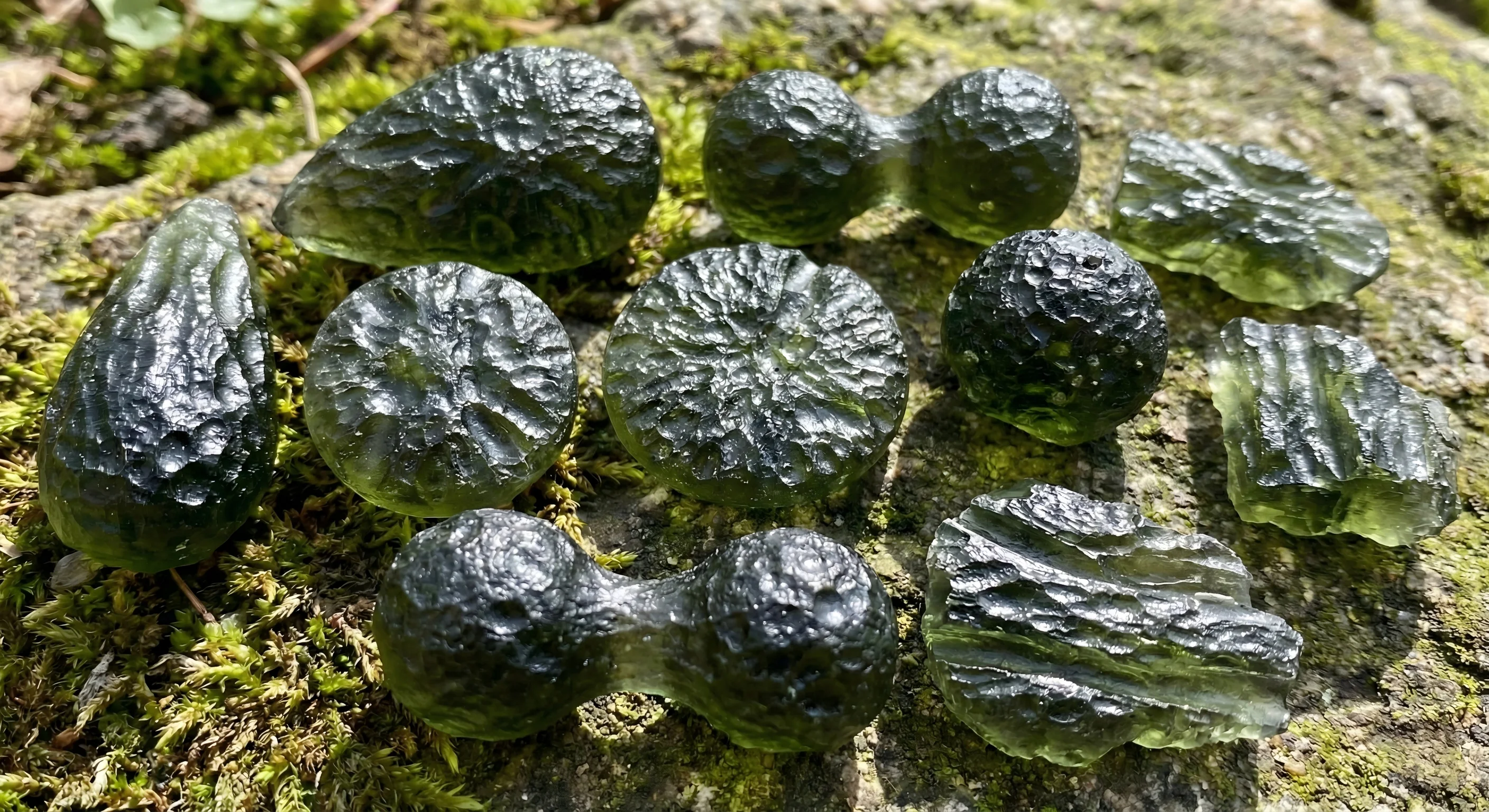

🔬 The Microscopic Lens: Exploring Internal Structures

Macroscopic evaluation is prone to error; microscopic evaluation is definitive. The instantaneous 2,000°C heat of a meteorite impact generates entirely different internal silica structures compared to the slow, controlled annealing process of commercial glass foundries. Select your optics below and drag across the stage.

1. Specimen Origin
2. Magnification Optics
10x Hand Loupe: At this standard jeweler's level, you will notice chaotic flow lines (schlierens) resembling syrup mixed in water. The Lechatelierite is barely visible as faint, abrasive threads resisting the optics.
SPECIMEN STAGE
DRAG ACROSS STAGE TO INSPECT INTERNAL GEOMETRY
🔍 The Darkfield Challenge: Finding Lechatelierite

You cannot simply hold a rough tektite up to a desk lamp with a cheap magnifying glass and expect to see Lechatelierite. The external textures are far too aggressive, scattering surface light and completely blinding your view into the interior. I have watched amateur geologists discard genuine specimens because they lacked the proper optical setup to see past the exterior pitting.

To view internal flow lines (schlierens) and Lechatelierite wires, you must utilize darkfield illumination. This requires submersing the specimen in a glass cell filled with a refractive index matching liquid (like benzyl benzoate or mineral oil). The liquid essentially "cancels out" the rough exterior texture, turning the stone into a clear window. You then push intense light horizontally through the liquid while looking down through a stereomicroscope at 20x to 40x magnification.

When you finally achieve focus, the difference is jarring. In a synthetic piece of glass, the interior is profoundly boring—a dead, homogenous green void occasionally interrupted by a perfectly round, stationary air bubble. In a genuine impact tektite, the interior is absolute chaos. The Lechatelierite looks like thick, invisible honey severely twisted and frozen in water. The gas bubbles are elongated, stretched into sharp torpedo shapes pointing in the direction of the ballistic flight path. Replicating this violent microscopic architecture in a controlled foundry is currently beyond the economic viability of modern counterfeiters.

📝 Specimen Classification Matrix

Objective classification requires aggregating multiple data points. Utilize this educational matrix to cross-reference observed macroscopic and microscopic characteristics, generating a theoretical classification profile based on established silicate parameters.

Observed Characteristics

Theoretical Classification

Awaiting Input

Select characteristics on the left to analyze the specimen's physical profile.

🔨 The Destructive Nature of Hardness Tests

Novices consistently default to the Mohs hardness scale. They read that tektites sit at approximately 5.5 on the scale, grab a piece of sharp quartz (hardness 7.0), and drag it across their newly acquired specimen. Stop doing this immediately. While scratching glass will indeed confirm it is softer than quartz, it tells you absolutely nothing about origin.

Commercial soda-lime glass, borosilicate glass, and natural impact silica all occupy the exact same narrow band of hardness (5.0 to 6.0). Scratch testing is functionally useless for separating a natural tektite from a synthetic replica. More importantly, it is a destructive test. I have examined countless authentic pieces irreversibly damaged by deep, ugly white gouges inflicted by owners trying to "prove" authenticity. You are destroying the structural integrity and aesthetic profile of a finite geological specimen to gather zero actionable data.

Instead of relying on destructive physical abrasion, professionals utilize non-invasive ultraviolet (UV) fluorescence. Tektites are compositionally inert under both long-wave and short-wave UV light; they absorb the light and appear completely dark. However, older synthetic glasses—particularly those manufactured prior to 2015—often contained trace uranium oxides or high manganese content to achieve a brighter green hue. When exposed to a $15 shortwave UV lamp, these specific synthetic replicas will violently fluoresce a neon, toxic-looking yellow-green. If it glows, it is unequivocally man-made.

🌍 Geological Origins vs. Artisan Foundries

A specimen's physical properties are directly dictated by its environmental origin. Explore the nodes below to differentiate the extreme kinetic environments of impact craters from the controlled thermal environments of modern silicate replication facilities.

The Central European Strewn Field

Approximately 15 million years ago, a massive kinetic event struck modern-day Germany. The extreme heat and atmospheric pressure melted terrestrial silica beds, ejecting the molten material vertically into the upper atmosphere. As it fell back to Earth, primarily scattering over the Czech Republic basins, the molten drops rapidly cooled into highly aerodynamic, structurally stressed natural tektites.

Geological Process
⛏️ The Reality of Excavation vs. Assembly Lines

The starkest difference between a genuine piece of impact glass and a synthetic replica is the labor required to extract it. By 2026, the easily accessible surface fields in Southern Bohemia have been systematically exhausted by decades of intense agricultural plowing and commercial extraction. Digging for raw tektites today involves securing expensive land leases, deploying heavy excavators to strip away meters of overburden, and carefully washing tons of heavy, sticky gravel to find a few grams of shattered green glass. It is dirty, exhausting, low-yield geological labor.

In sharp contrast, industrial replication facilities operate on massive economies of scale. I have reviewed footage from overseas silicate foundries operating continuous-flow kilns at 1,200°C. They can produce thousands of flawless, deeply green, heavily textured glass replicas in a single 24-hour shift. The artisans operating these kilns are highly skilled in material science, successfully mimicking the exact specific gravity and surface tension of natural stones by manipulating the chemical composition of the glass cullet.

We must separate the artisan from the subsequent market presentation. The glassworkers are producing a remarkable, durable product—a testament to human engineering. The friction occurs exclusively when these engineered replicas are moved through secondary distribution networks and presented as ancient geological artifacts. From an educational standpoint, both the tektite and the synthetic replica are fascinating objects of study; they simply require different analytical paradigms to appreciate.

Educational References & Further Reading

AUTH_SIG_VERIFIED
ENCRYPTION_ACTIVE

Investigator Profile

Hi, I’m Emily Carter, a long-time crystal researcher and writer with a special focus on Moldavite and high-vibration tektites. For over a decade, I’ve studied the geological origins and spiritual interpretations of rare stones, combining scientific literature with mindful, experience-based insight. This blog is where I share what Moldavite has taught me about transformation, awareness, and inner alignment.

Moldavite enthusiasts
Access Full moldavite geology origins Database