Fluid Dynamics Simulator
Sphere / Oblate
Dominated by internal fluid cohesion. In a relatively balanced descent without severe lateral forces, surface tension pulls the silica into the smallest possible surface area.
Forget the metaphysical marketing brochures. What you are looking at is the forensic aftermath of a catastrophic kinetic event. 14.8 million years ago, a violent meteorite impact ejected molten silicates into the upper atmosphere. The falling glass underwent two brutal phases of natural sculpting: atmospheric reentry dynamics and deep-time acidic corrosion.
Stop looking for "perfect" symmetrical specimens in impact glass. Nature does not optimize for aesthetic symmetry during a 20-kilometer-per-second atmospheric reentry. It optimizes for mass dissipation and fluid cohesion under extreme thermal stress.
Dominated by internal fluid cohesion. In a relatively balanced descent without severe lateral forces, surface tension pulls the silica into the smallest possible surface area.
When we run these fluid dynamic simulations in the lab, we are attempting to reverse-engineer a moment of absolute chaos. I have spent a decade analyzing impact melt ejecta, and the common misconception is that these droplets gracefully cooled while floating through the stratosphere. They did not. The formation of primary shapesâspheres, teardrops, and dumbbellsâis a violent negotiation between molten silica viscosity, hypersonic atmospheric drag, and severe thermal gradients.
Consider the physical reality. At the moment of ejection from the Ries crater impact site, the temperature of the target rock spiked beyond 2500°C in milliseconds. The quartz and silicates did not just melt; they flashed into a highly volatile liquid state, carrying trapped gases. As this material was violently ejected into the upper atmosphere, it was immediately subjected to atmospheric braking. We are talking about deceleration forces that would shatter modern aerospace composites.
The Ugly Truth About Shape Preservation: Here is the friction point most collectors ignore. You want a perfect dumbbell shape? You have to accept a massive trade-off in structural integrity. To form a dumbbell, the molten droplet must spin wildly, centrifugal forces pulling the mass to the two poles and creating a thin, stretched "neck." However, silica glass is notoriously poor at handling uneven thermal contraction. As that thin neck cools faster than the bulbous ends, immense internal tension builds. The very mechanics that create the beautiful shape almost guarantee its destruction.
This is why finding an intact primary shape is not a matter of "luck" or "energy"; it is a statistical anomaly of brittle fracture mechanics. We estimate that over 90% of the highly elongated primary shapes experienced catastrophic structural failure either in mid-air due to thermal shock or upon kinetic impact with the Miocene terrain. What you see preserved in collections today are the statistical survivorsâthe thick, stubby, structurally boring pieces, or the extremely rare aerodynamic forms that happened to land in highly forgiving, soft clay deposits.
The Mathematics of Shattered Glass
A frequent error in geological cataloging is assuming the fragmented shards we dig up are primary shapes. They are secondary debris. The impact velocity with the terrestrial surface was unforgiving.
The aerodynamic flight ended in seconds. The terrestrial sculpting took 14.8 million years. The coveted "Hedgehog" texture is not a sign of origin; it is a symptom of severe geological corrosion in highly acidic gravels.
Simulation: Removing the protective exterior to reveal differential silica dissolution.
A smooth surface retaining aerodynamic streamlining. Often preserved in dense, impermeable clay beds where water circulation is restricted.
A stormy landscape of microscopic pits and razor-sharp silica peaks. The result of humic acids dissolving the glass matrix over millions of years.
I have spent countless seasons in the South Bohemian strewn fields, specifically around locations like Besednice and Chlum. Let me dispel a romantic notion right now: the soil does not care about aesthetics. It is a slow, methodical, chemical reactor. When we talk about "secondary etching," we are describing the literal dissolution of the glass matrix by groundwater.
The texture of impact glass is entirely dictated by the stratigraphy of its burial site. If a tektite lands in the dense, impermeable Moravian clays, it is effectively hermetically sealed. The water cannot flow, the pH remains neutral, and the glass emerges 14 million years later looking almost exactly as it did the day it fellâsmooth, glossy, with shallow, subtle pitting. It is geologically pristine, yet often ignored by those seeking extreme textures.
The Trade-off of the Hedgehog: Now, contrast this with the sandy gravels of the Besednice region. These soils are highly permeable and historically covered by dense Miocene forests. As organic matter decayed, it released humic and fulvic acids into the groundwater. For 14.8 million years, this weakly acidic water constantly washed over the buried glass. Because impactite is an inhomogeneous mixture of silica and other trace minerals (like aluminum and iron), the acid eats away the softer, silica-poor areas faster than the silica-rich areas. This differential dissolution creates the famous, razor-sharp "Hedgehog" spikes.
But here is the reality check: you trade durability for that texture. I have handled deeply etched specimens that literally crumbled under the pressure of a thumb. The deep etching introduces microscopic stress fractures throughout the body of the glass. The highly sculpted pieces are structurally compromised husks of their former selves. We must handle them with the same delicacy reserved for brittle ancient ceramics, not solid glass.
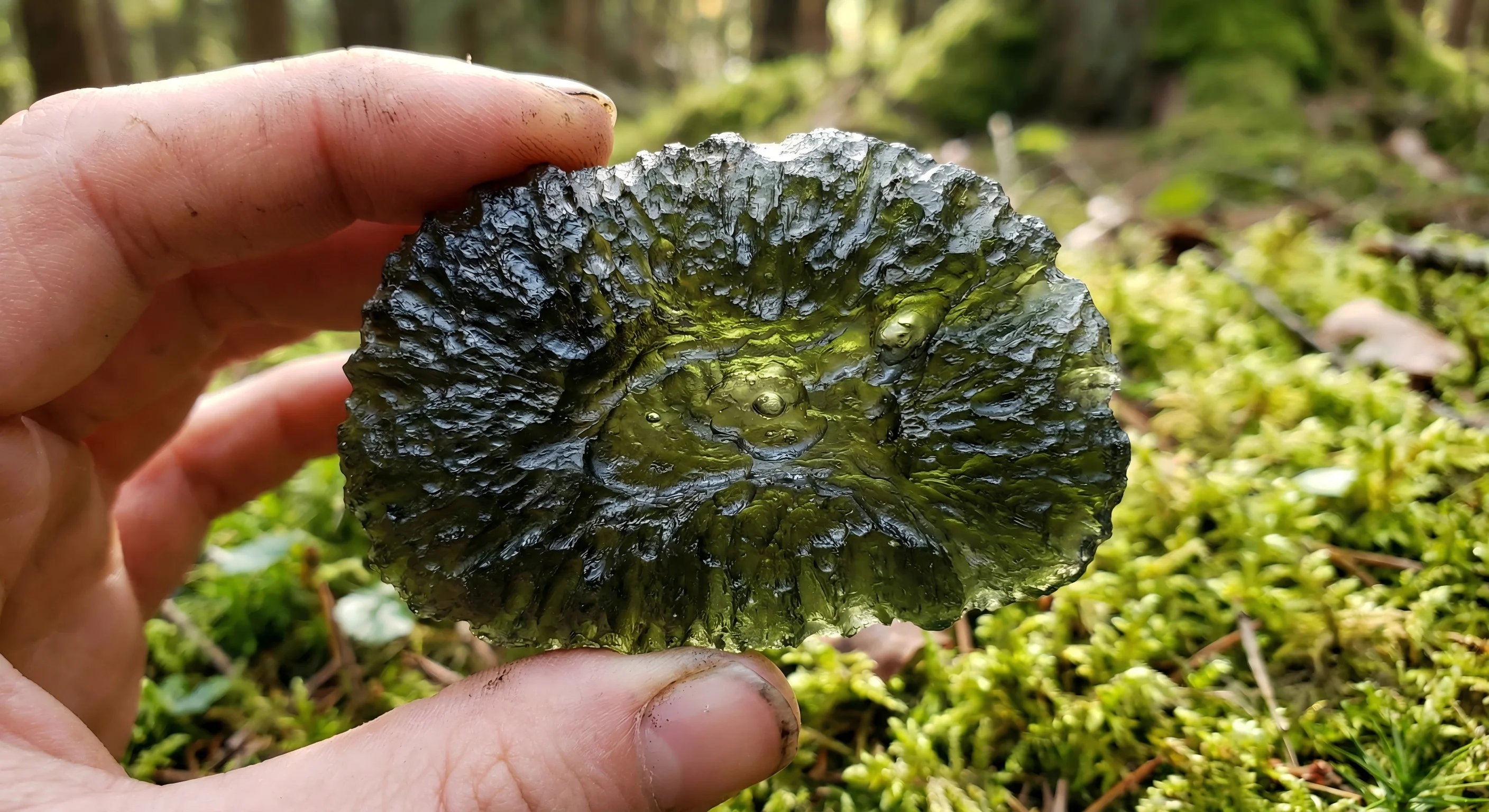
Macroscopic textures can be mimicked by modern hydrofluoric acid dips, but internal micro-structures cannot be faked. We look past the surface, comparing the trapped stress networks of high-velocity impact ejecta against the lazy, static cooling patterns of terrestrial volcanic glass.
Profile: Liquefied at extreme temperatures (2500°C+), subjected to immense kinetic stretching, and rapidly quenched at 20 km/s.
Profile: Magma naturally extruded on the Earth's surface, cooling relatively slowly and statically without extreme kinetic trauma.
Put down the magnifying glass and step up to a proper stereomicroscope with a polarizing filter. When I train new geology undergraduates, the first thing I force them to look at is the internal flow structure. Obsidian is lazy. It is terrestrial glass born from slow-moving lava flows. It cools somewhat predictably. Impact glass, however, is frozen trauma.
The defining physical evidence of a kinetic impact origin lies in Lechatelierite. This is an amorphous mineraloidâessentially pure silica glass (SiO2). It forms only when quartz grains in the target rock are subjected to temperatures exceeding 1700°C instantly. Because the impact melt is a chaotic mixture of different minerals melting at different rates, the pure silica does not have time to homogenize with the rest of the melt.
The Sensory Reality of Microscopic Inspection: When you adjust the focus knob on the microscope, looking into a sliver of impactite, you don't see a uniform green void. You see violently twisted wires and ribbons of glass suspended within glass. Because Lechatelierite has a lower refractive index than the surrounding host glass, these flow lines appear as distinct, raised welts or swirling optical distortions. They look like clear syrup stirred into water, flash-frozen mid-swirl.
Furthermore, observe the bubbles. In factory-produced glass or slow-cooling volcanic glass, bubbles are spherical. They face uniform pressure. In impact glass, the bubbles are elongated, stretched like microscopic torpedoes. This happens because the glass was highly viscous and cooling rapidly while simultaneously being subjected to the extreme G-forces of atmospheric flight. The internal physics simply cannot be replicated by any terrestrial or artificial process.
Test your comprehension of impact geology mechanics.
Based on fluid dynamics and micro-observations, which feature serves as the most definitive physical evidence of "supersonic atmospheric flight"?
đŻ Diagnostic Correct.
Macroscopic features like hedgehog pitting are secondary results of localized soil etching, completely dependent on the burial environment. However, the internal directional Lechatelierite textures and elongated bubbles are indelible physical evidence baked in during the high-speed atmospheric flight. They represent irreversible structural strain.
â ď¸ Diagnostic Error.
You are confusing secondary terrestrial erosion with primary kinetic formation. Macroscopic shapes (like pits or spheres) can be obscured by millions of years of geological processing or altered by the impact itself. Only the internal crystal distortionâcaused by extreme heat and hypervelocity atmospheric dragâprovides an immutable physical record of the flight.
Investigator Profile
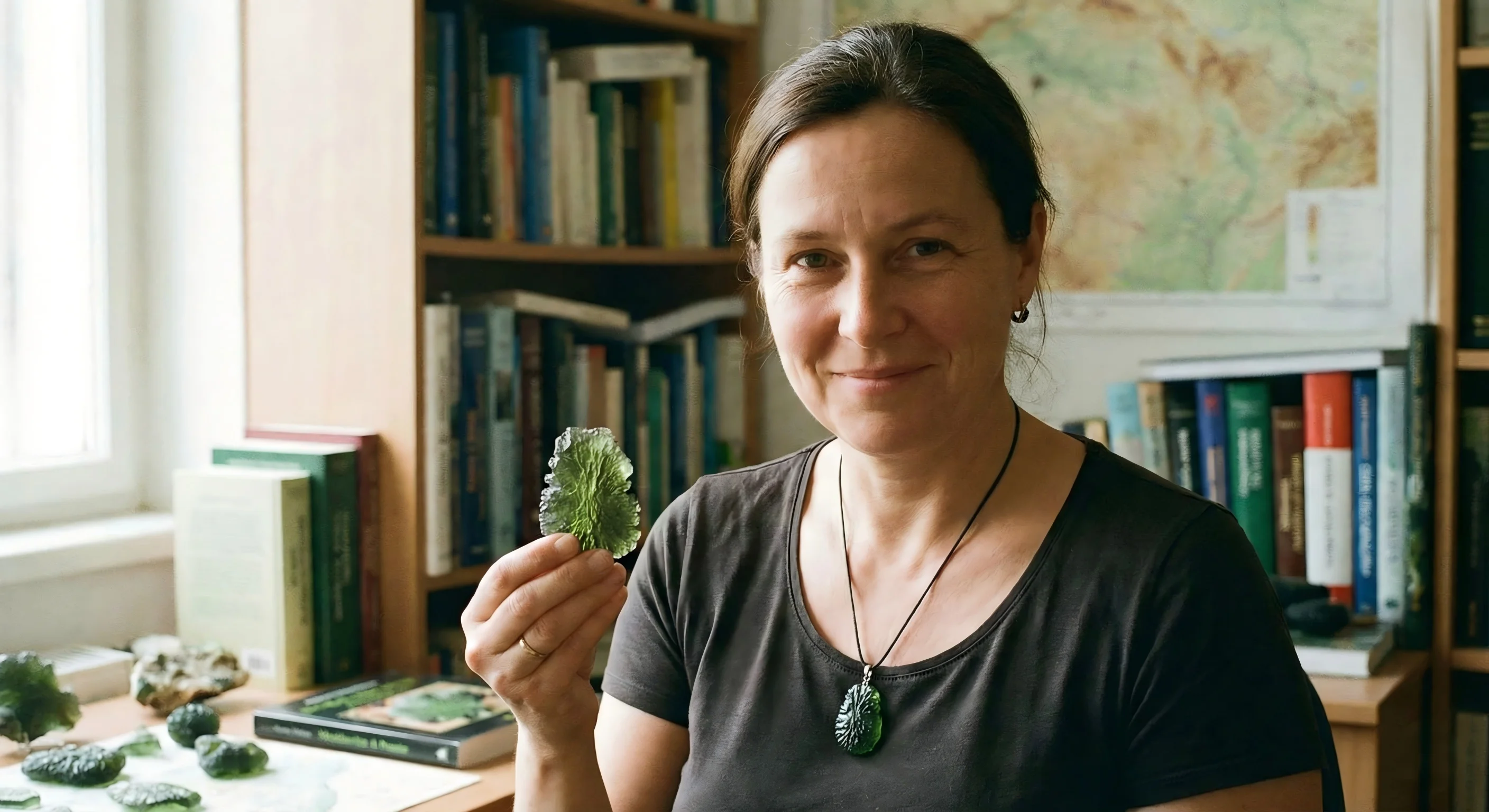
Hi, Iâm Emily Carter, a long-time crystal researcher and writer with a special focus on Moldavite and high-vibration tektites. For over a decade, Iâve studied the geological origins and spiritual interpretations of rare stones, combining scientific literature with mindful, experience-based insight. This blog is where I share what Moldavite has taught me about transformation, awareness, and inner alignment.