Why Quartz Cleaning Methods Will Destroy Your Tektite
Quartz routines become a problem for tektite when they blur two separate things: ritual familiarity and material behavior. The issue is not that every quartz cleansing method will instantly ruin every tektite. The issue is that misapplying quartz care assumes a hard crystalline mineral and a natural impact glass can tolerate the same rubbing, soaking, salt contact, heat, residue, storage, and repeated handling.
They cannot be treated as the same object.
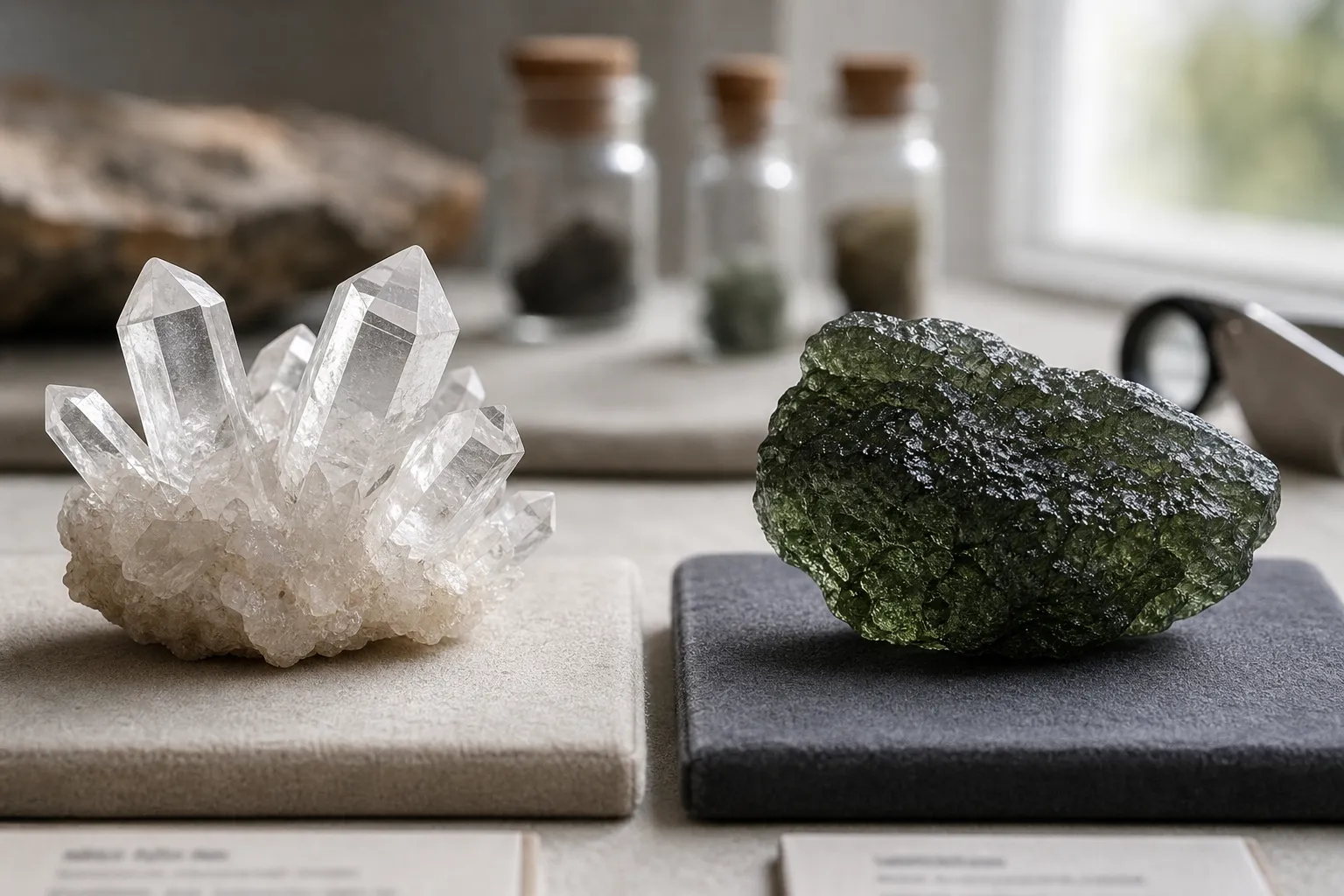
Quartz is commonly described as a crystalline mineral with Mohs hardness 7. Tektites, including moldavite, are natural impact glasses. Moldavite studies also describe internal pores, bubbles, inclusions, and structural variability. That is enough reason to stop copying quartz cleaning rituals and move toward gentler tektite specimen care.
broader context
Start with the main moldavite page
This narrower page makes more sense after the broader moldavite archive page.
The common mistake: turning a ritual habit into a care rule
Many people meet tektite through the same language they use for quartz: cleansing, charging, intention, clearing, moonlight, smoke, salt, water, or earth contact. That language may be meaningful in a personal or spiritual practice. It becomes a care problem when it turns into a physical instruction for the object.
A ritual question asks
“What feels symbolically cleansing?”
A specimen-care question asks
“What touches the surface, for how long, with what moisture, grit, pressure, residue, temperature change, or abrasion?”
Those are different questions.
Quartz rituals often feel casual because quartz is familiar, common, and comparatively hard. People may rinse it, wipe it, place it with other stones, bury it, or use salt-adjacent practices without thinking much about surface vulnerability.
Tektite is not “dark quartz,” “green quartz,” or quartz under another name. Geological references describe tektites as naturally occurring glass objects formed from material melted during an extraterrestrial impact and scattered across strewn fields. Moldavite is the Central European tektite most readers here are usually asking about.
That distinction should come before any cleansing choice. A glassy impact object should not inherit quartz habits just because both appear in the same crystal-care conversation.
Hardness helps, but it is not the whole answer
The shorthand “hardness 7 vs 5.5” is useful as a warning, but it can be overused. Mohs hardness is a scratch-resistance scale. It does not fully explain brittleness, impact resistance, internal strain, surface texture, heat tolerance, residue, or how one specific specimen will respond to repeated handling.
For tektite, the practical point is simpler: do not assume it has quartz’s margin for rough contact.
The strongest available support here is the category difference. Quartz is a crystalline mineral. Tektites are impact glasses. Moldavite specimens can vary internally, with studies describing pores, bubbles, inclusions, and different textures between and within samples.
That does not prove that every brief contact with water, smoke, or salt will damage a tektite. It does mean quartz-style confidence is too casual.
A quartz habit can encourage:
- rubbing more than necessary;
- contact with gritty materials;
- long exposure to moisture or residue;
- loose storage with harder stones;
- repeated ritual handling as if the piece were tough;
- cleaning for appearance instead of preserving the natural surface.
The better assumption is modest: handle tektite as an impact-glass specimen, not as a quartz point.
Quartz cleaning habits that are a poor fit for tektite
The sources available for this page do not provide a tested damage chart for every cleansing method. So the right conclusion is conservative, not theatrical: avoid quartz routines that add unnecessary grit, pressure, soaking, heat, residue, or rough contact.
Salt bowls and gritty contact
Salt is often used symbolically in traditional cleansing rituals. As a ritual idea, that belongs to a different conversation. As object care, loose grains create contact points.
If a tektite is placed into dry salt, rubbed with salt, or stored where salt crystals press against its surface, the ritual has become an abrasive handling event. The concern is not a proven universal chemical reaction. The concern is that a glassy specimen with surface texture and possible internal variability does not benefit from grit.
If the symbolic use of salt matters, keep the salt separate from the tektite.
Long soaking because quartz “can handle it”
Water routines are common in quartz care language. For tektite, avoid making soaking part of a routine unless you have specimen-specific guidance.
This is not a claim that water automatically damages every tektite. It is a practical boundary: do not add moisture exposure simply because quartz routines normalize it.
If a piece needs physical cleaning, start with the lowest-contact assumption: minimal handling, no soaking ritual, no scrubbing, and no unnecessary chemicals.
Sunlight, heat, and temperature swings
Some quartz routines use sunlight or warmth as part of charging or cleansing. The sources for this page do not establish a direct rule that ordinary sunlight will damage every tektite. Still, tektite is glass, and moldavite can be structurally variable.
The useful question is not, “Will a few minutes near a window ruin it?” The useful question is, “Does this method add heat or temperature change for no material-care reason?”
If it does, skip it.
Smoke, oils, sprays, and residue
Smoke cleansing may be lower-contact than rubbing or soaking, but it can still leave residue depending on what is burned, how close the specimen is held, and how often the practice is repeated. Oils, sprays, perfumes, incense ash, and handling residue create the same problem: a symbolic act can become a surface-cleaning issue later.
The boundary is simple. Anything that deposits material on the tektite should not be treated as automatically harmless.
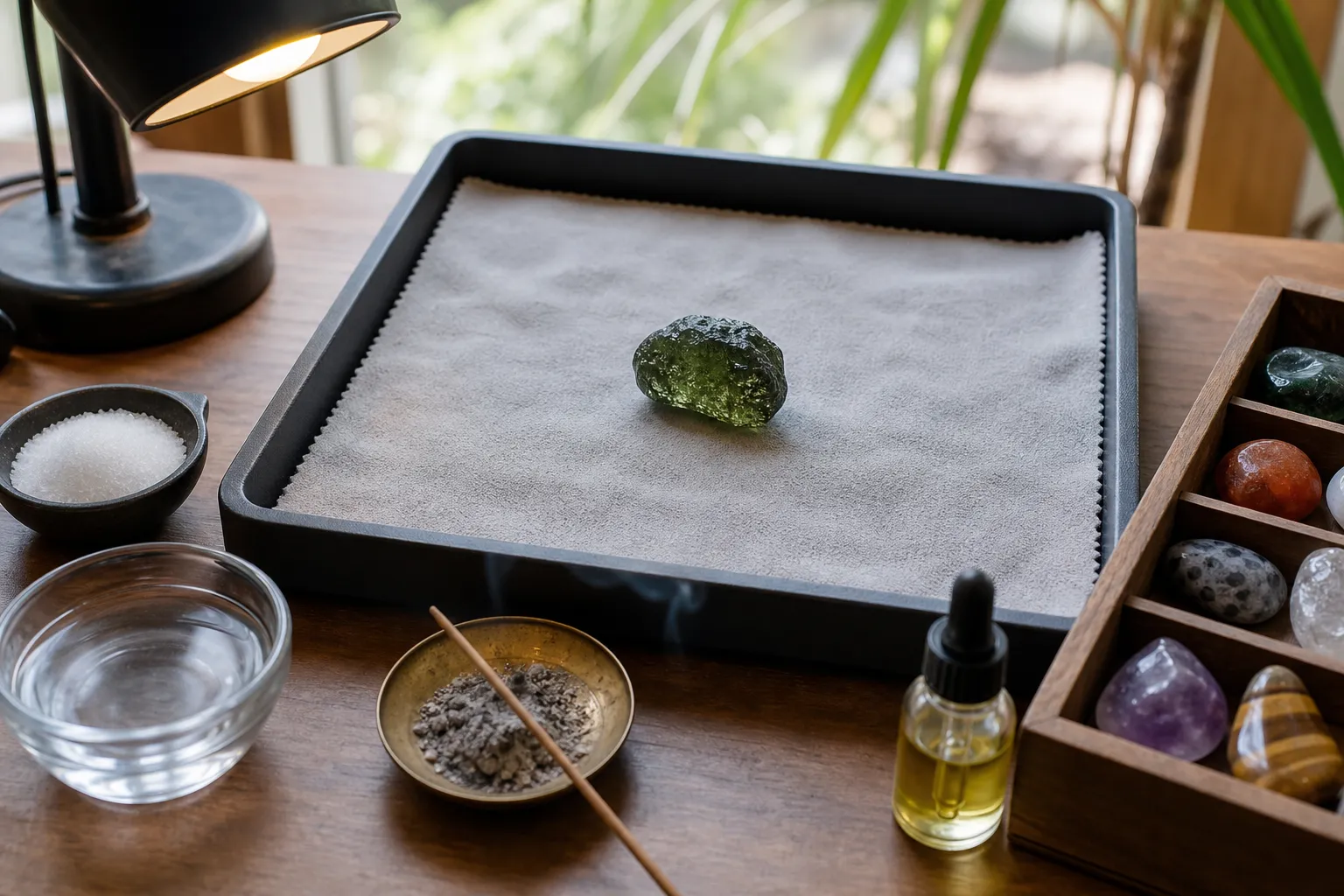
Bowls of mixed stones
Quartz is often placed with other stones in bowls, grids, or display trays. Tektite should not be treated as a loose filler stone.
Contact with harder minerals can raise scratch or chip risk during ordinary handling, especially if the bowl is moved, shaken, or rearranged. A separate pouch, lined tray, or stable display position is a better fit.
Separate symbolic cleansing from physical cleaning
You do not have to abandon ritual language to protect the object. The cleaner solution is to separate the symbolic act from the physical specimen.
If an intention practice matters to you, choose a version that does not make the tektite endure quartz-style treatment. Place the specimen near a ritual object rather than inside it. Use sound, breath, prayer, meditation, visualization, written intention, or a clean display setting without soaking, burying, salting, rubbing, heating, or coating the piece.
The point is not to rank spiritual practices. The point is to stop asking the tektite to carry the physical burden of the ritual.
For physical cleaning, think more like a specimen caretaker:
- handle the piece less, not more;
- avoid grit and pressure;
- avoid repeated wet routines;
- avoid chemicals unless a qualified source gives a clear reason;
- do not use ultrasonic cleaners as a casual default;
- store the tektite away from harder stones;
- preserve natural surface texture instead of polishing it into “cleanliness.”
This matters especially with moldavite, where natural form, surface character, and geological context are part of the object’s identity. Over-cleaning can be a bigger mistake than leaving the piece alone.
What the evidence supports — and what it does not
The strongest support for this answer is geological, not anecdotal. The available material supports these points:
- quartz is a crystalline mineral commonly described as Mohs hardness 7;
- tektites are natural impact glasses, not quartz under another name;
- moldavite belongs to the tektite category;
- moldavite specimens can show pores, bubbles, inclusions, and internal structural variability;
- quartz habits should not be transferred automatically to a different material category.
The evidence does not support a dramatic universal list saying that salt, water, sunlight, smoke, burial, soap, or a single wipe will definitely destroy every tektite. That would require care-specific testing, museum or conservation guidance, or well-documented handling evidence beyond the current source base.
So the practical answer is cautious: quartz care for tektite is unsafe as an assumption. The damaging part is the habit of copying methods without checking the material. Once you recognize tektite as impact glass rather than quartz, the default changes from “cleanse it the way I cleanse quartz” to “keep the ritual low-contact and the specimen handling gentle.”
A simple decision rule
Before using any quartz cleaning method on tektite, ask:
- Does this involve rubbing, grit, pressure, soaking, heat, residue, or contact with harder stones?
If yes, it is a poor default. - Am I doing this for symbolism or because the object is physically dirty?
If it is symbolic, choose a no-contact or low-contact version. - Will this preserve the natural surface, or am I trying to make an impact glass look cleaner than it needs to look?
If appearance is driving the action, pause. - Am I assuming quartz rules apply because the ritual is familiar?
If yes, that is the category error to avoid.
Often, the safest routine is almost no routine: careful storage, clean hands, minimal handling, and ritual practices that happen around the object rather than directly on it.
Short answers
Can I cleanse tektite the same way I cleanse quartz?
Not as a default. Quartz and tektite are different materials. You can keep symbolic cleansing language if it matters to you, but avoid copying quartz cleaning rituals that involve grit, soaking, rubbing, heat, residue, or rough contact.
Is the hardness comparison enough to decide care?
No. The Mohs comparison is a useful caution, but it only describes scratch resistance. It does not fully describe brittleness, internal structure, surface texture, inclusions, pores, or specimen condition.
What is the safest approach if I am unsure?
Use lower-contact care. Keep the tektite separate from harder stones, avoid abrasive or wet rituals, do not over-clean it, and let symbolic cleansing happen around the object rather than directly on it.