Moldavite Emotional Release
Ripping Off the Scab: Navigating Relationship Breakups During the “Flush”
A breakup during what you call a Moldavite Emotional Release can feel like the scab came off before the wound was ready. It may feel timed, symbolic, catalytic, or spiritually charged.
The grounded answer is this: Moldavite can be a mirror for reflection, but it is not proof that a relationship was destined to end, divinely removed, toxic, or meant to be saved. Treat the “flush” as emotional weather around the breakup, not as the judge of the relationship itself. Your next steps should come from observable reality: safety, consent, repeated patterns, boundaries, accountability, support, and time.

When the breakup feels like part of the Moldavite “flush”
In Moldavite circles, people often use words like “the flush,” “emotional purging,” “shadow work,” or “trauma release” to describe a period when buried feelings seem to rise fast. During a breakup, that language can feel painfully accurate: memories replay, old grief wakes up, your body feels flooded, and the relationship suddenly looks different.
That does not mean the stone caused the relationship ending.
A more careful way to hold it is: the breakup may be happening during a season when Moldavite has become a symbol of change for you. The stone may mark the period. It may focus your attention. It may give you a ritual object to hold while you ask difficult questions. But the relationship decision still belongs to human reality.
Ask yourself
- Were there problems before Moldavite entered the picture?
- Were boundaries already being crossed?
- Did either person stop feeling safe, respected, or willing?
- Was the ending sudden, or had it been building quietly?
- Are you interpreting pain as proof, or as a signal to slow down?
A breakup can be meaningful without being “caused.” It can reveal something without issuing a cosmic verdict. It can hurt sharply without proving that the suffering itself is the point.
What should guide the decision instead
When the breakup is fresh, your mind may want one clean explanation: the stone entered, emotions surged, the relationship cracked, and now the ending feels spiritually arranged.
A story can comfort you. It should not replace discernment.
Look at the relationship through ordinary evidence:
Safety
Do you feel physically and emotionally safe around this person? If there are threats, coercion, stalking, intimidation, fear of saying no, self-harm threats, or pressure that makes you feel trapped, this is not mainly a crystal interpretation question. Prioritize immediate human support, local emergency help, or qualified services in your area.
Consent and willingness
Is closeness being chosen freely by both people? If one person is forcing contact, reconciliation, silence, or emotional access, that matters more than any spiritual timing.
Repeated patterns
One painful conversation is different from a pattern of contempt, betrayal, avoidance, manipulation, or neglect. Write down what actually happened so you can separate a bad moment from a recurring dynamic.
Boundaries
What boundary was crossed? Was it named clearly? Was there repair? Was the repair consistent, or did the same issue keep returning?
Outside perspective
Trusted friends, family members, counselors, or support people may not share your Moldavite framework, but they can still help you notice patterns you are too flooded to track.
Time
A breakup during emotional intensity can feel final in the morning and reversible by night. Unless there is an immediate safety issue, slowing down can protect you from decisions made out of panic, guilt, spiritual pressure, or withdrawal.
Research on breakup distress points to a simple, useful boundary: relationship endings can bring real emotional strain, and that strain is shaped by things like attachment patterns, perceived control, rumination, avoidance, betrayal, and support. That evidence does not validate Moldavite causality. It does support the wisdom of not treating raw emotion as the whole truth.
The common confusion: “If it hurts this much, it must be release”
Spiritual language can give pain a container. That can help. It becomes risky when every wave of distress is treated as confirmation that the breakup is spiritually correct.
Pain can mean many things.
- It can mean you loved someone.
- It can mean a bond was interrupted.
- It can mean you are afraid of abandonment.
- It can mean a boundary finally became visible.
- It can mean your body is reacting to shock.
- It can mean the relationship was harmful.
- It can also mean the relationship mattered and still ended.
Calling the experience “emotional purging” may describe how it feels, but it does not prove what is happening underneath. “Trauma release” is especially weighty language. If old memories, panic, dissociation, severe depression, self-harm thoughts, or an inability to function are showing up, do not intensify the spiritual interpretation. Get qualified human support.
A safer wording is often more honest:
- “This breakup is bringing up old material,” rather than “Moldavite is releasing my trauma.”
- “This relationship may be showing me a pattern,” rather than “Moldavite proved this person was wrong for me.”
- “I need time and support before deciding,” rather than “The flush has decided.”
- “This hurts, and I can care for myself through it,” rather than “If I suffer enough, I will be transformed.”
Moldavite as a symbolic mirror is useful when it helps you ask better questions. It becomes less useful when it turns grief into a test you think you must pass.
A grounded journal page for breakup grief
Journaling through a Moldavite emotional release breakup is not about building a case against your ex or proving the flush is real. It is about giving the flood somewhere to go.
Try four short columns:
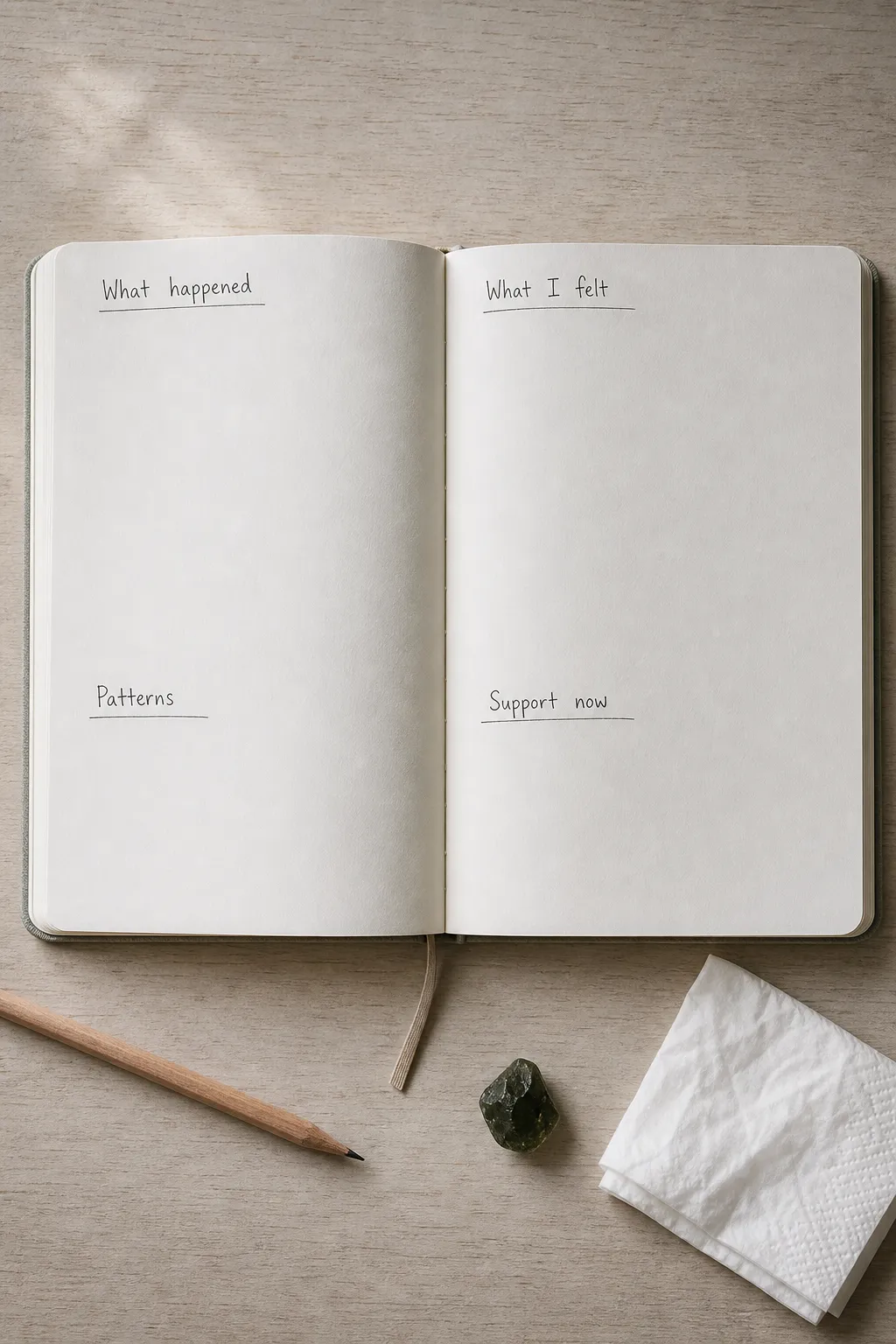
1. What happened
Write observable events only. “We argued for three hours.” “They canceled twice.” “I ended the call.” “They said they were unsure.” This keeps symbolism from swallowing the facts.
2. What I felt
Name the emotional layer: grief, rage, shame, relief, panic, longing, numbness, jealousy, tenderness. Feelings deserve space, but they are not always instructions.
3. What pattern this may connect to
This is where shadow work language may fit, if it stays humble. Did the breakup touch an old fear of being left? A habit of over-functioning? Choosing unavailable partners? Difficulty saying no? Write “may” often. Certainty is not required.
4. What support or action is needed now
Sleep. Eat. Wait before texting. Call a grounded friend. Arrange professional support if needed. Return belongings with help if direct contact feels unsafe. Mute social media for a while. Take a walk. Drink water.
Let the spiritual layer exist, but keep the page accountable to reality.
If you want to decide everything today
Breakups create urgency. Was this meant to happen? Should you fight for it? Did you ruin it? Did Moldavite expose the truth? Is this the beginning of your transformation?
Some questions cannot be answered while you are emotionally flooded.
If there is no immediate safety concern, consider a short pause before making major decisions. A pause is not denial. It is letting the first wave pass before choosing from a steadier place.
During that pause:
- Do not use the stone as an oracle for yes-or-no decisions.
- Do not reread messages for hours if it leaves you more distressed.
- Do not punish yourself for missing someone.
- Do not force a “higher meaning” before the grief has had room to be ordinary.
- Do not isolate completely, even if you need privacy.
- Do not escalate contact if the other person has asked for space.
A steadier rhythm is usually more humane: feel, write, move, eat, sleep, talk to someone grounded, then revisit the question later.
What Moldavite can and cannot mean here
Moldavite can mean
- “I am paying attention.”
- “This period of my life feels exposed.”
- “I want to look at patterns I used to avoid.”
- “I need a physical reminder to stay honest with myself.”
Moldavite cannot responsibly be made to mean
- “This relationship must end.”
- “This person was spiritually removed from my life.”
- “My pain is definitely trauma leaving my body.”
- “I need help, safety support, counseling, mediation, legal guidance, or crisis resources.”
That boundary is not anti-spiritual. It is protective. A symbol is most useful when it deepens your agency, not when it takes agency away.
If the relationship ended during the Moldavite flush, you may choose to mark the event spiritually. Put the stone away for a few days if it feels too charged. Hold it while journaling if that helps you stay present. Use it as a reminder not to abandon yourself. Let the breakup belong to a larger season of change if that framing feels true.
Just do not let the story outrun the evidence.
A simple discernment check
Before you call the breakup “Moldavite Emotional Release,” ask:
- Am I using spiritual language to understand my grief, or to avoid it?
- Am I calling the ending fated because uncertainty feels unbearable?
- What would I think about this relationship if Moldavite were not involved?
- What did the relationship repeatedly show me before the breakup?
- What do I need in the next 24 hours: meaning, care, distance, support, or safety?
- Who can help me stay grounded without taking over my decision?
If your answers point to danger, coercion, severe distress, or inability to function, prioritize qualified support in your area. If they point to sadness, confusion, longing, and reflection, give yourself time. Breakup grief changes shape. What feels like a cosmic command on day one may look like a human pattern by week three.
The most balanced interpretation is this: a breakup during the “flush” can be spiritually meaningful to you without being spiritually proven. Let Moldavite be a mirror, a marker, or a meditation object. Let your relationship choices be made through safety, consent, patterns, boundaries, support, and time.