Digital boundary note
The Digital Detox: Why Moldavite and Smartphones Don't Mix
Moldavite and smartphones do not need to be kept apart because Moldavite blocks phone radiation. The better reason is simpler: in crystal practice, Moldavite is often treated as intense, activating, disruptive, or clarifying, while a smartphone is built to pull attention outward through alerts, feeds, messages, and constant reachability.
If you are searching for EMF Sensitivity Crystals, the most grounded way to understand Moldavite phone separation is as a digital-detox and attention-boundary ritual. It is not EMF protection, not a symptom solution, and not evidence that your phone is physically harming you.
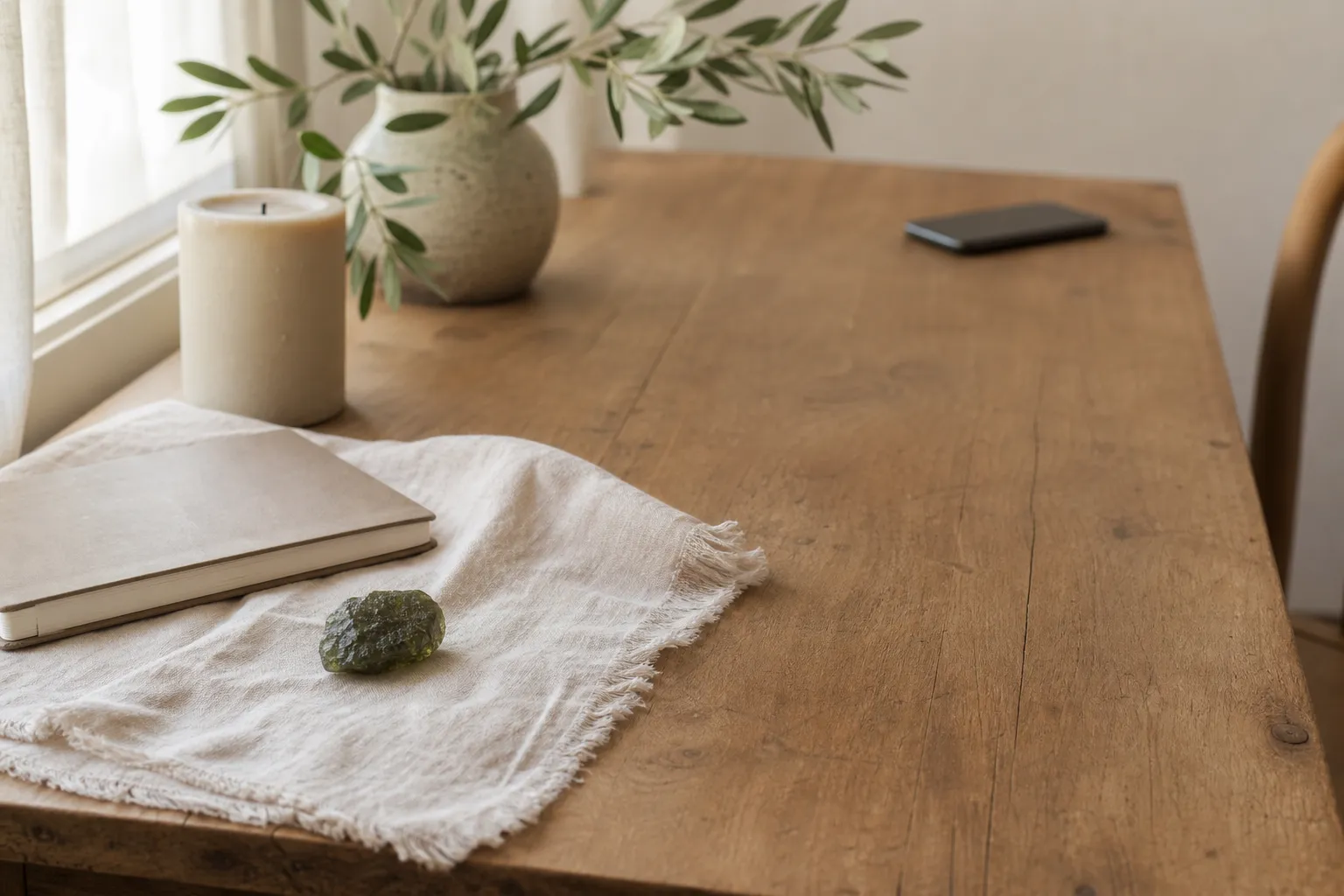
The real reason Moldavite and smartphones “don’t mix”
In Moldavite-centered spiritual language, the stone is rarely described as soft background energy. People often approach it as a catalyst: something that can make inner noise feel louder, push buried questions forward, or make everyday habits harder to ignore.
Whether you take that language literally, symbolically, or somewhere in between, it points to one practical truth: Moldavite practice works best when you can notice what is happening in your attention.
A smartphone does the opposite. It compresses work, social pressure, entertainment, shopping, news, photos, maps, memories, and emergencies into one object. Even when the screen is dark, the phone can carry the feeling of interruption. A crystal altar with a phone charging in the center of it may not feel restful because the phone is not emotionally neutral in daily life. It represents obligation.
So “Moldavite and smartphones don’t mix” can be useful when it means:
- keeping a spiritual practice space free from notification loops;
- letting Moldavite mark a screen break rather than another reason to stay online;
- separating inner reflection from constant checking;
- using the stone as a reminder to pause before reaching for the phone.
The phrase becomes risky only when it turns into a physical safety claim: that Moldavite neutralizes phone emissions, makes a smartphone safer, or functions as EMF protection. The available evidence does not support that framing.
Gemologically, Moldavite is a natural glass associated with tektite material. That identity belongs in geology and gemology. It does not, by itself, establish a protective effect against radiofrequency exposure from phones.
What Moldavite phone separation can honestly mean
A phone-free Moldavite ritual can be meaningful without becoming a radiation claim. The most grounded version is an attention boundary.
You might place Moldavite on a desk, shelf, or altar where the phone does not sit. You might charge your phone outside the bedroom and keep Moldavite beside a journal instead. You might choose ten minutes when the phone is on silent, in another room, or face down across the space.
The point is not that the crystal is shielding you from the device. The point is that the separation makes your intention visible.
Felt patterns readers may recognize
- “I feel scattered after scrolling.”
- “My head feels tight after long screen sessions.”
- “I reach for my phone before I know what I need.”
- “Moldavite feels too activating when I am already overstimulated.”
Grounded ritual uses
- Before journaling: put the phone in another room so the stone is associated with inward attention, not content consumption.
- Before sleep: keep the phone away from the bed if that helps reduce checking, alerts, or late-night scrolling.
- During meditation: use Moldavite in a phone-free space, especially if you already experience the stone as intense.
- During work breaks: let the stone mark a break from screens rather than a reason to research more EMF claims.
Those experiences can be real in an ordinary human sense without proving one single cause. A Moldavite digital detox can serve as a ritual answer to digital overload.
This practice is modest, and that is its strength. It does not need to promise a health outcome. It simply makes the boundary concrete.
Where EMF sensitivity language needs care
“EMF sensitivity,” “electromagnetic hypersensitivity,” and similar terms are commonly used by people who report symptoms they associate with electromagnetic fields or wireless devices. Public-health discussions generally treat these as reported symptom experiences while remaining cautious about assigning everyday electromagnetic exposure as the cause in each case.
That distinction matters. A person may sincerely feel worse around screens, routers, phones, bright workstations, or busy digital environments. The stress or disruption may be real. But that does not mean a crystal has been shown to address those symptoms, and it does not mean a phone explains every headache, sleep issue, or anxious feeling that appears near technology.
Smartphones emit radiofrequency energy and are subject to safety standards and regulatory review. Agencies such as the FCC and FDA provide mainstream safety context for cell phone radiofrequency exposure. That context should not be turned into fear language inside a crystal ritual. It also does not erase the everyday reality that heavy phone use can feel mentally noisy, socially demanding, and hard to put down.
Moldavite phone separation may support a calmer relationship with your screen habits. It should not be described as Moldavite EMF protection.
Tech headache, screen overwhelm, and one-cause stories
“Tech headache” is a useful phrase because many people know what it means: tight eyes, mental fatigue, irritation, pressure after long sessions, or a sense of being overstimulated by devices. But it is also a broad phrase. It can point to screen duration, posture, lighting, hydration, stress, sleep habits, workload, notifications, visual strain, or worry about exposure.
That is why spiritual language works best here when it stays symbolic. You might say, “My Moldavite practice shows me when my phone use is too much.” That is different from saying, “My phone and Moldavite create a harmful field.” The first statement describes personal meaning. The second makes a physical claim.
If your screen discomfort is occasional and clearly tied to overwork or too much scrolling, a digital overload ritual may be a reasonable comfort practice: step away, dim the environment, silence the device, drink water, rest your eyes, journal, or take a walk. Moldavite can be part of that pause if it helps you avoid re-entering the same loop immediately.
If symptoms are persistent, severe, new, neurological, sleep-disrupting, or anxiety-provoking, a stronger crystal arrangement is not the next step. Consider speaking with a qualified health professional. A phone-free ritual can coexist with ordinary care, but it should not replace evaluation when symptoms interfere with daily life.
Shungite trays, Faraday bowls, and the mixed-message problem
Searches around Moldavite and smartphones often overlap with market language: Shungite tray claims, Faraday bowl claims, anti-radiation stickers, phone chips, shielding pouches, and crystal grids for devices. These terms can blur the original question.
A Shungite tray may be sold as a place to put a phone. A Faraday bowl may be described as a shielding container. Some products borrow technical language from materials science or radiofrequency engineering. But those claims require product-specific evidence, measurement conditions, and independent testing. They cannot be casually transferred to Moldavite, a decorative tray, a mixed crystal bowl, or a spiritual altar.
The narrower point is this: the available material for this page does not show that Moldavite, Shungite trays, Faraday bowls used in wellness settings, or crystal phone arrangements provide reliable protection from smartphone emissions.
The ritual purpose and the engineering purpose are different.
A modest ritual claim
If you put your phone in a bowl across the room so you stop checking it, that may support a screen boundary.
A stronger technical claim
If you claim the bowl changes the health impact of the phone, you have moved into a much stronger technical and health-outcome claim.
A clear Moldavite practice should not blur those two.
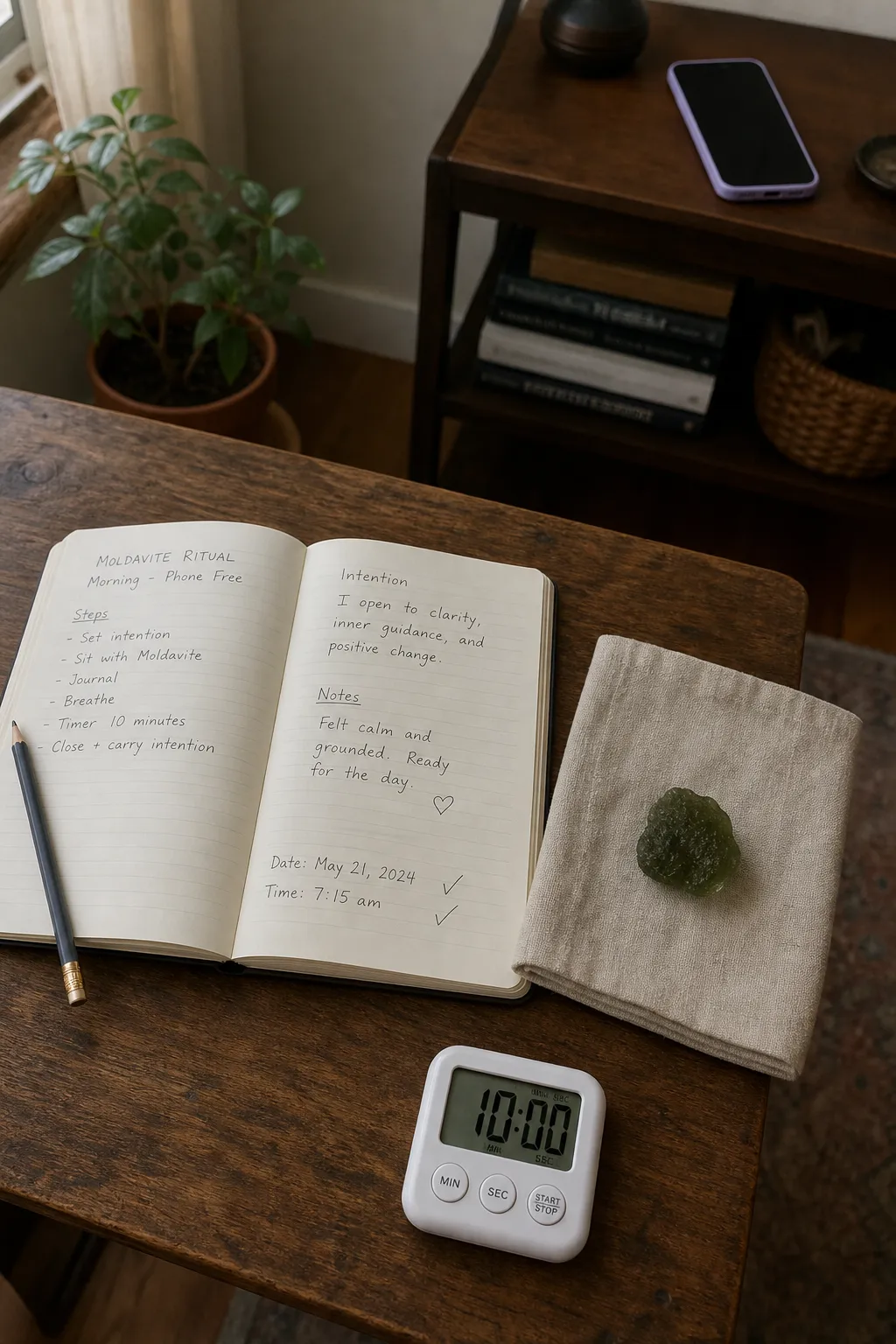
A simple phone-free Moldavite ritual
The most useful version of this practice is intentionally low-tech and low-claim.
Choose one place where your phone does not go. It can be a bedside table, a meditation shelf, a writing desk, or a small cloth where you keep Moldavite. The separation is the ritual. You are not building a shield. You are building a habit.
Try this structure
- Name the boundary.
Decide what the space is for: reflection, journaling, prayer, meditation, planning, or quiet. - Move the phone first.
Put it on silent, place it outside arm’s reach, or charge it in another room. Do not make Moldavite responsible for doing what a changed habit can do directly. - Use Moldavite as a cue.
Let the stone mean: “I am not available to the feed right now.” That symbolic role is enough. - Keep the session short if Moldavite feels intense.
Five to fifteen minutes is a reasonable starting frame for many personal rituals. Longer is not automatically better. - Close before returning to the phone.
Write one sentence, take a breath, or put the stone away. Make re-entry intentional rather than automatic.
This kind of Moldavite phone separation is not anti-technology. It is anti-compulsion. It treats the phone as a powerful attention object and Moldavite as a reminder to choose when that object gets access to you.
When keeping them together is not a problem
There is no need to become rigid. Carrying Moldavite in a bag that also contains a phone does not automatically create a crisis. Taking a photo of Moldavite with a smartphone is not a contradiction. Using your phone to document a specimen, compare authenticity notes, or photograph surface texture is normal collector behavior.
The separation matters most when the phone is interfering with the purpose of the moment. If you are meditating, journaling, sleeping, or trying to decompress, the phone may be the stronger object in the room—not because of unseen danger, but because of habit design. If you are cataloging a Moldavite piece, checking lighting, or taking a macro image, the phone is simply a tool.
A good boundary should make your life clearer, not smaller.
The bottom line
Moldavite and smartphones “don’t mix” as a symbolic and practical matter: Moldavite practice often asks for presence, while smartphones often fragment it. Keeping them apart can be a meaningful digital overload ritual, especially if you use Moldavite as a cue for silence, journaling, sleep boundaries, or screen-free reflection.
The limit is just as important. Moldavite is not established as an EMF shield. EMF Sensitivity Crystals is reader and search language, not proof of a protective mechanism. Tech headache, electromagnetic hypersensitivity language, Shungite tray claims, and Faraday bowl claims all need careful boundaries.
If the separation helps you put the phone down, it may be worthwhile. If it becomes a promise that a crystal changes what smartphone emissions do to the body, the claim has gone beyond what the evidence can support.