Grounded practice
Progressive Energy Attunement: Adapting Your Body to Higher Frequencies
High-vibration frequency attunement is best approached slowly: brief spiritual practice, clear grounding, rest, and honest reflection. That might mean a few minutes of meditation, prayer, breath awareness, crystal contact, or energy-focused journaling followed by food, movement, ordinary chores, and sleep.
The core answer is simple: let your body set the pace. Intensity is not automatically progress. If words like energetic alignment, aura expansion, or spiritual homecoming help you describe your inner life, use them as spiritual and symbolic language—not as proof of a measurable frequency change, a guaranteed effect, or a crystal mechanism.

broader context
Broader moldavite archive
This narrower page makes more sense after the broader moldavite archive page.
What progressive energy attunement means in practice
Progressive energy attunement means adapting gradually to practices, objects, places, or inner states that you experience as “high vibration.” For someone drawn to moldavite, that may include sitting quietly with a stone, setting an intention before sleep, praying with it nearby, or noticing sensations and emotions that arise during contemplation.
The important word is progressive. You are not trying to overwhelm yourself, prove sensitivity, or make every session feel cosmic. You are building a steadier relationship with subtle experience.
A grounded progression can look like this
- First contact: Spend a few minutes with the practice or stone and notice what arises.
- Gentle repetition: Return another day without quickly increasing intensity.
- Grounding: Reconnect through food, walking, touch, simple chores, or time outdoors.
- Integration: Ask how the experience affects your mood, boundaries, choices, or sense of meaning.
- Adjustment: Reduce, pause, or simplify if the practice starts to feel destabilizing.
Energetic alignment may feel like becoming more coherent with your values or intuition. Aura expansion experiences may feel like warmth, spaciousness, emotional softness, or a wider sense of presence. Spiritual homecoming may feel like recognition: not that something outside you has confirmed your destiny, but that a moment or symbol helped you feel closer to yourself.
Those meanings can be honored without overstating them.
Start small, then close the session clearly
A common misunderstanding is treating high vibration and grounding as opposites. In practice, they belong together. If a session opens you emotionally or spiritually, grounding gives that openness somewhere safe to land.
Begin with a short window: a few minutes of quiet contact, intention-setting, meditation, or reflection. Then close the session deliberately.
You might
- put the stone down if you are using one;
- stand up and feel your feet;
- drink water if that feels settling;
- touch a table, floor, tree, or piece of cloth;
- name the room you are in;
- choose one ordinary task to do next.
This is not a formula for a guaranteed result. It is a way to keep spiritual attention connected to daily life.
Some people describe body responses during energy-focused practice: tingling, warmth, pressure, emotion, vivid dreams, sudden tears, or a feeling of expansion. Research on contemplative practice has documented that some meditators report energy-like sensations such as vibration, current, movement, or intensity. That does not establish a metaphysical mechanism. It does support a practical point: inner practices can feel powerful, and pacing matters.
If you are new to energetic alignment practices, avoid stacking too many intensifiers at once. Do not combine a new stone, long meditation, fasting, sleep loss, intense breathwork, and emotionally charged music just to see what happens. Change one thing at a time so you can understand your own response.
Signs the pace is probably right
Gentle pacing for attunement is not passive. It is attentive.
The pace may be appropriate when
- you feel more present after the session, not scattered for the rest of the day;
- emotions arise but remain workable;
- you can return to eating, sleeping, work, conversation, and basic responsibilities;
- the experience gives insight without demanding an immediate life overhaul;
- you feel curious rather than compelled;
- journaling energetic patterns brings clarity instead of obsession.
Rest days for energy practice are part of the process, not a failure. Meaning often deepens between sessions. A rest day might include no stone work, no formal meditation, and no search for signs. You simply live, notice, and let the previous experience settle.
A useful journal entry can stay plain
- What did I do?
- How long did I do it?
- What did I notice in the body?
- What emotions appeared?
- What changed afterward?
- Did I sleep normally?
- Do I feel more grounded or less grounded today?
This kind of record helps protect you from exaggeration. It also shows whether a practice is genuinely supportive in your life or whether you are chasing intensity because it feels meaningful in the moment.
When intensity means slow down
Attunement without forcing requires a different relationship to intensity. A strong experience may be meaningful, but it is not automatically wiser, higher, or more spiritually advanced.
Slow down or pause if you notice panic, dissociation, insomnia, dizziness, worsening distress, compulsive practice, or difficulty functioning in ordinary life. Do not frame those experiences as necessary purification, an energetic upgrade, or proof that you are becoming more spiritually powerful.
If distress is persistent, severe, or interfering with daily life, consider support from a qualified medical or mental health professional. For urgent safety concerns, seek local emergency or crisis support. This does not invalidate your spiritual interpretation; it simply recognizes that human experience has more than one layer.
It is also wise to reduce intensity when spiritual language starts making you less grounded
- “I feel open” is easier to integrate than “my aura has permanently expanded.”
- “This stone is symbolically powerful for me” is steadier than “this stone is forcing my destiny.”
- “I need rest” is safer than “I must push through because this is an upgrade.”
- “I had a strong experience” is more accurate than “I know exactly what frequency changed.”
These wording choices matter. They allow spiritual meaning without turning every sensation into an instruction.
Moldavite, high vibration, and symbolism
Moldavite is a real material with a real geological identity: a natural glass associated with a meteorite impact event. Its physical nature can be discussed separately from its spiritual reputation. Collectors may focus on origin, texture, authenticity, and visible characteristics. Spiritually curious readers may relate to moldavite as a symbol of acceleration, disruption, awakening, or return.
Those two layers should not be collapsed into one claim. The fact that moldavite is an unusual tektite does not prove that it changes an energy field. At the same time, a person can have a sincere inner response to moldavite as an object of contemplation, beauty, memory, or symbolic force.
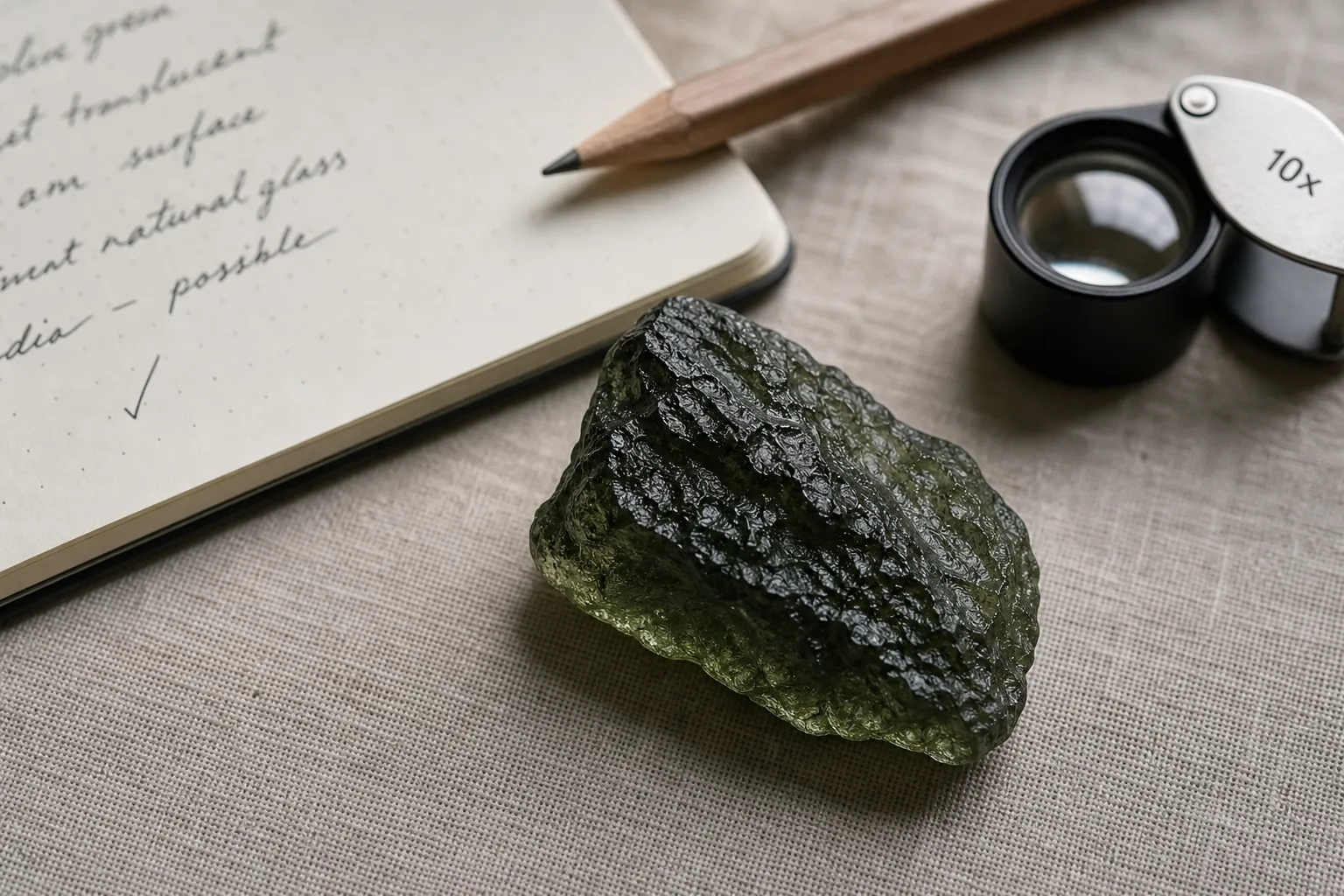
If you use moldavite in progressive energy attunement, keep the practice modest
- Begin with short contact rather than all-day wear.
- Avoid sleeping with it at first if you already feel overstimulated.
- Pair it with grounding routines, not just more intensity.
- Notice whether your response is emotional, bodily, symbolic, expectation-driven, or a mix.
- Take breaks without interpreting the break as rejection or failure.
For some readers, moldavite may feel like spiritual homecoming. For others, it may feel like too much, or like nothing at all. All three responses fit within an experiential frame.
A grounded rhythm for integration after energy work
Integration after energy work is where attunement becomes usable. Not because it proves a frequency shift, but because it shows whether the experience can live inside your actual life.
After a session, ask one grounded question: What does this help me meet more honestly?
The answer may be simple. You may need more rest. You may need to stop overcommitting. You may feel moved to clean your room, apologize, make art, spend time outside, or stop seeking signs for a few days. These ordinary actions are not less spiritual than the peak moment. Often, they are where the meaning becomes real.
A balanced rhythm
- Open gently. Set an intention without demanding an outcome.
- Listen briefly. Notice sensations, emotions, images, or silence.
- Close clearly. End the session instead of drifting indefinitely.
- Ground physically. Eat, walk, stretch, wash dishes, or step outside.
- Record lightly. Journal patterns without turning every detail into a prophecy.
- Rest. Let the practice echo before adding more.
This rhythm keeps high vibration connected to grounded embodiment. It also prevents a common confusion: assuming that more energy language means more wisdom. Sometimes wisdom is the moment you stop, breathe, and choose not to intensify.
The real limit of “higher frequency” language
On this page, “higher frequencies” belongs mainly to spiritual and symbolic vocabulary. It can describe how a person experiences clarity, love, openness, reverence, or inner movement. It should not be treated as a measurable bodily frequency unless a specific measurable process is being discussed in a scientific context.
Likewise, energetic alignment, aura expansion, and spiritual homecoming are interpretive frames. They may help you name an experience, but they should not pressure you to perform one.
A mature approach to high-vibration frequency attunement is honest, paced, and embodied. You allow meaningful experiences to arise, but you do not surrender your discernment to them. You respect intensity, but you do not worship it. You let grounding be part of the spiritual path rather than a retreat from it.
If the practice leaves you clearer, kinder, steadier, and more able to inhabit your life, that is worth noticing. If it leaves you destabilized, sleepless, fearful, or unable to function, the next step is not to push harder. The next step is to pause, simplify, and get support if needed.
Progressive attunement is not about proving that you can handle higher frequencies. It is about learning how much openness your life can integrate with care.