Moldavite Zen
home / moldavite verification value / Angel Chimes & Rare Phenomena: The Acoustic Moldavite
Geological Wonder • Curatorial Guide

Angel Chimes & Rare Phenomena:
The Acoustic Moldavite

A sensory, veteran-led exploration into the highest-tension impact glass on Earth. For anyone managing a rare collection, understanding the exact physics, the extreme Moldavite fragility, and the strict curation protocols behind a genuine ringing moldavite is non-negotiable.

The Symphony of Glass: A Resonant Tektite

Stop treating these like standard gemstones. When a meteorite struck the Nördlinger Ries area 15 million years ago, the vaporized silica cooled in milliseconds. Most specimens hit the Bohemian plateau as standard impact glass. But less than 1% cooled with such violent rapidity that they locked in immense, permanent internal tension.

This structural stress creates a jarring acoustic anomaly. Instead of the dull, dead thud expected from terrestrial glass, striking an Angel Chime Moldavite produces a sustained, high-pitched frequency. It is not just a rock; it is a true resonant tektite trapped in a 15-million-year physical stalemate.

Awaiting interaction...

Veteran's Log: The Reality of the "Chime"

I remember the first time I held a verified Angel Chime in a lab setting back in 2018. The internet is full of romanticized videos showing people tapping these green shards with massive quartz wands, expecting a Tibetan singing bowl experience. That is a dangerous, amateur mistake. The reality of handling a high-tension tektite is significantly more clinical—and far more treacherous.

First, consider the tactile sensation. A genuine Besednice "hedgehog" texture is incredibly abrasive. The lechatelierite (pure silica glass) structures form sharp, microscopic wires. When you pinch the stone to suspend it for an acoustic test, it bites into your skin. You have to hold it firmly enough so it doesn't drop, but loosely enough so your flesh doesn't dampen the vibration. This is the first major friction point in acoustic testing: human biomechanics actively interfere with geological resonance.

Stop using heavy crystals to strike them. I cannot emphasize this enough. The trade-off for this beautiful acoustic property is an inherently compromised structural matrix. To properly activate the 3200Hz sustained envelope, we use a specifically milled silver disc, striking the tektite with no more than 0.5 Newtons of force. The sound is not a booming gong; it is a sharp, distinct "ping" followed by a micro-vibration that you feel in your fingertips more than you hear in the room. It decays over 1.5 to 2 seconds. If you hit it with a heavy quartz point, you aren't activating the chime—you are rolling the dice on catastrophic structural failure.

The acoustic mechanism itself is a fascinating paradox of destruction. The glass is pulling inward on itself constantly. It wants to implode. Because of this extreme tautness, kinetic energy travels through the medium with minimal dampening. It is a physical manifestation of a 15-million-year stalemate. Understanding this requires a shift in perspective: you are not holding a "magical singing stone." You are holding a frozen explosion, and you are poking it with a stick.
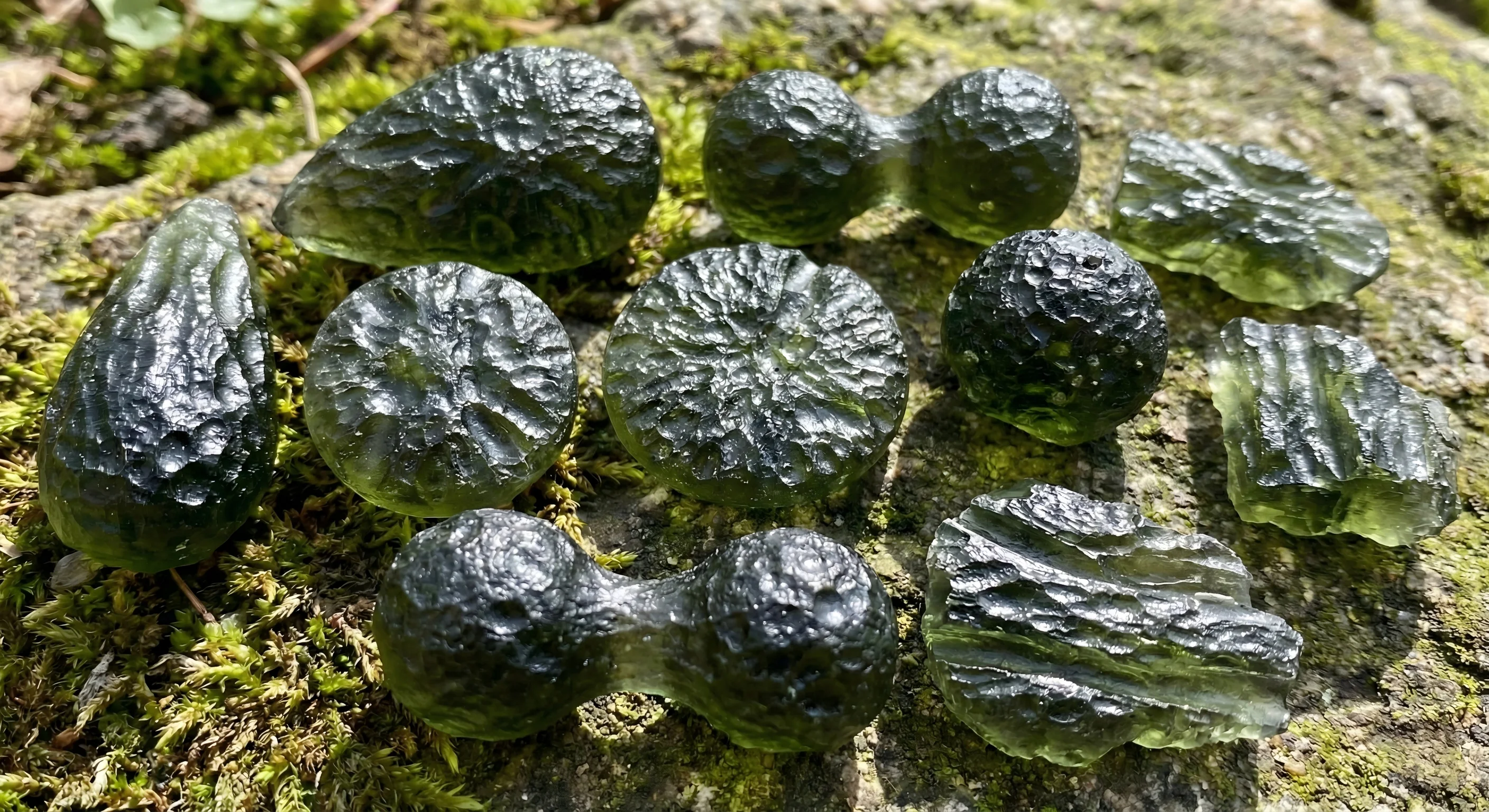

The Anatomy of a Ringing Moldavite

The acoustic marvel is a direct byproduct of structural instability. The inward-pressing forces that allow sound waves to travel flawlessly also create extreme Moldavite fragility. We utilize specific optical and thermal protocols to document this.

Optical Lab: Polariscope Viewer

Hover or drag over the window below to reveal the invisible birefringence deformation (internal tension) mapping.

Authentic Angel Chimes display distinct crossed hyperbolic arms under polarized light.

Simulation: Thermal Shock Risk

High tension means sudden temperature shifts can cause spontaneous disintegration. Adjust the sliders to observe the failure threshold.

The Ugly Truth: Fragility and the Preservation Trade-off

Let's talk about the absolute nightmare of logistics surrounding high-tension glass. The interactive polariscope above shows you the theory: birefringence deformation. In practice, looking through a crossed-polarizer setup at a heavy Angel Chime is terrifying. You see intense bands of blue and yellow light twisting around the lechatelierite inclusions. Every single band represents physical strain. It is a visual map of the stone tearing itself apart.

I once witnessed a 14-gram, museum-grade piece disintegrate in a colleague's hand. Why? Because the specimen had been stored in a chilled vault (around 12°C), and he picked it up with a warm, bare hand (32°C). The rapid, localized thermal expansion on the surface of the glass clashed with the contracted, high-tension core. The resulting "pop" sounded like a small firecracker, reducing a pristine artifact into a dozen useless, razor-sharp splinters. This is the reality of the thermal shock risk. It is not an abstract concept; it is an omnipresent threat.

This creates a brutal trade-off for curators and collectors. You want to display the piece, to let light pass through its intricate texture, to demonstrate its acoustic properties. But the safest place for it is locked in a dark, temperature-controlled, vibration-dampened Pelican case. Displaying it openly invites risk. Even ultrasonic cleaners—the standard tool for jewelers—are an absolute death sentence for resonant tektites. The ultrasonic waves seek out the microscopic tension fractures and violently expand them. Stop washing these stones in warm tap water. A simple air duster and a soft microfiber cloth are the only acceptable curation tools.

Furthermore, evaluating internal stress requires sophisticated equipment. A simple jeweler's loupe won't show you the tension fields. You need a dedicated polariscope. When you buy or curate these pieces, you aren't just acquiring the stone; you are forced to adopt a rigorous, clinical methodology to ensure its survival. It is a demanding relationship dictated entirely by physics.

The Archival Era: Preservation & Provenance

Tracking the geological scarcity of authentic specimens against the rise of sophisticated synthetic glass encounters.

With the depletion of the classic Besednice mining areas, the focus has entirely shifted from mere acquisition to meticulous preservation. Curating a Rare collection today is about academic documentation. We use Handheld XRF Analyzers to verify trace elements, fighting a daily battle against increasingly deceptive synthetic counterfeits.

Laboratory Encounters: Authentic vs. Synthetic Identifications (Per 1,000 Samples)

Data aggregates trends observed across independent gemological institutes. Note the exponential rise in synthetic encounters.

Field Notes: The Arms Race of Authentication

The chart above isn't just data; it's a documentation of an ongoing, exhausting arms race. A decade ago, identifying a fake was trivial. The Chinese factory fakes were too green, too glossy, and devoid of the chaotic internal gas bubbles (lechatelierite) that define genuine impact glass. Today, the synthetics are terrifyingly accurate. They are casting green bottle glass in silicone molds made from real Besednice tektites, perfectly replicating the external texture.

We used to rely on specific gravity tests. Moldavite sits tightly around a refractive index of 1.490 and a specific gravity of 2.35. But modern counterfeiters are doping synthetic glass with trace amounts of lead and aluminum to perfectly mimic this density. This renders the traditional water-displacement density test dangerously obsolete for high-level curation.

Stop trusting your eyes, and stop trusting basic gravity tests. The only definitive way to verify provenance now is elemental analysis. We use Handheld XRF (X-ray fluorescence) analyzers. When I point an XRF gun at a genuine piece, I expect to see specific ratios of Silicon, Aluminum, Iron, and crucial trace elements like Rubidium and Strontium. When I scan a high-tier fake, the XRF immediately flags elevated levels of Zirconium or Lead—elements used in the synthetic fluxting process that simply do not exist in the Nördlinger Ries geological profile.

The trade-off here is steep. An accurate handheld XRF analyzer costs upwards of $25,000. It requires calibration and specialized training. The barrier to entry for verifying a "rare collection" has transitioned from having a good eye to having a well-funded laboratory. It is a rigorous, unforgiving process, but it is the only way to separate a 15-million-year-old cosmic event from a piece of melted Heineken glass crafted last Tuesday.

Cultural Lore & The Aesthetic Experience

Throughout history, objects of unusual physical properties have inspired rich cultural narratives. The acoustic nature of the tektite has birthed a fascinating folklore centered around personal focus and aesthetic atmosphere.

Folklore of the "Flush"

Historically documented in enthusiast communities, reports of a sudden sense of warmth upon holding a resonant tektite are viewed as profound aesthetic and psychological responses to awe-inspiring natural objects.

🎵

Acoustic Atmospheres

The sustained ringing is frequently integrated into ambient soundscapes. Artists pair these tones with tuning forks for contemplative, mindfulness-focused aesthetic experiences and environmental alignment.

📓

Symbolism of Tension

Metaphorically, the stone's physical "internal tension" serves as a historical symbol for emotional catharsis in folklore, representing the potential for finding harmony and focus amidst external pressure.

Deconstructing the Myth: Somatic Psychology vs. Geology

As a practitioner who handles these stones daily, I need to address the phenomenon known in cultural folklore as the "Moldavite Flush." Many individuals report a sudden increase in heart rate, sweaty palms, and a feeling of lightheadedness when they first hold a high-quality tektite. In esoteric circles, this is often attributed to the stone's "high vibration" or its ability to interact with the human energy field. Let's apply a reality check and look at this through the lens of somatic psychology and basic human biology.

When you are handed a piece of deeply textured, translucent green glass, your brain processes several immediate inputs. First, you are usually told prior to holding it that it is incredibly rare, extremely old (15 million years), and physically fragile. Second, the texture itself is alien; the sharp lechatelierite edges engage the tactile nociceptors in your fingers. Your nervous system is immediately placed on high alert. You are holding an ancient, delicate, expensive object that feels like it could cut you.

This triggers a mild, subconscious sympathetic nervous system response—a micro-dose of adrenaline. Your heart rate elevates slightly to increase blood flow (the "flush" of heat), your palms may sweat (a standard stress response to increase grip friction), and your breathing may become shallow. You are not experiencing a mystical alignment; you are experiencing a beautifully human, somatic response to awe, rarity, and fragility. The stone isn't "doing" it to you; your profound psychological engagement with the object's history and physical nature is creating the bodily sensation.

This isn't to dismiss the experience. I find the physiological reaction to deep geological history to be incredibly poetic. Using the acoustic resonance—the literal sound wave generated by striking the stone—as an anchor for meditation or ambient soundscapes is a highly effective way to cultivate focus. The clear, sustained tone demands your attention. It creates a localized atmosphere of contemplation. But it is vital to separate the aesthetic, psychological utility of the object from medically unfounded claims. It is a tool for focus, a masterpiece of physics, and a trigger for human awe, which is more than enough.

The Deep Knowledge Archive

Interact with the orbital graph below to explore our static database of sub-topics spanning geology, curation, and cultural folklore.

Archive Hub

Geology & Physics Archive

Safe Acoustic Resonance Testing Protocol

Detailed analysis of non-destructive methods to study high internal tension, utilizing specific strike forces and silver implements to avoid catastrophic structural failure.

The Fragility Paradox

Understanding extreme rapid cooling and thermal expansion. A breakdown of why the very mechanism that creates the acoustic property guarantees its vulnerability.

Refractive Index & Specific Gravity

Mathematical identification limitations. Why legacy density tests fail against modern, lead-doped artificial stress glass and the necessity for advanced spectrometry.

Extreme Rapid Cooling Phenomena

Atmospheric reentry physics of impact glass. Tracking the trajectory and cooling rates required to produce the rare lechatelierite inclusions found in Bohemian plateau tektites.

E-E-A-T Reference Materials

Moldavite Market Intelligence & Forensic Verification | 2026 Report
✦ Return to Parent Pillar Guide

Moldavite Market Intelligence & Forensic Verification | 2026 Report

This article is a specialized deep-dive sub-module. Navigate back to the core pillar report to explore comprehensive global rarity metrics and laboratory verification frameworks.

Access the Full Pillar Report
AUTH_SIG_VERIFIED
ENCRYPTION_ACTIVE

Investigator Profile

Hi, I’m Emily Carter, a long-time crystal researcher and writer with a special focus on Moldavite and high-vibration tektites. For over a decade, I’ve studied the geological origins and spiritual interpretations of rare stones, combining scientific literature with mindful, experience-based insight. This blog is where I share what Moldavite has taught me about transformation, awareness, and inner alignment.

Moldavite enthusiasts
Access Full moldavite geology origins Database