Moldavite Zen
home / moldavite geology origins / 14.8 Ma Impact Analysis: The Ries Event & Tektite Formation
Planetary Science Module

Cosmic Impact: The Ries Event Analysis

Some 14.8 million years ago, the silence of the Miocene landscape was shattered not by a predator, but by a physics event so extreme it temporarily liquefied the continental crust. This digital report analyzes the Nördlinger Ries hypervelocity impact, guiding you through the creation of one of Earth's most intriguing geological curiosities: Moldavite.

Event Parameters

Epoch: Middle Miocene (Langhian)
Impactor Density: ~2500 kg/m³ (Stony)
Target Lithology: Crystalline Basement + Sediment
Pressure Shock: > 60 GPa
Resulting Material Distal Ejecta (Tektites)

1. Impact Physics Simulation

The difference between a standard meteorite strike and a hypervelocity event lies in the state of matter. At speeds exceeding 15 km/s, the impactor acts less like a rock and more like an explosive charge. Adjust the parameters below to replicate the conditions necessary to vaporize granite and launch the silica melt into the upper atmosphere.

Control Panel

5 km/s 10 km/s 50 km/s
0.1 km 0.5 km 5.0 km
Estimated Energy Release
Calculating...
Megatons TNT Equivalent
Adjust parameters to start simulation.

The Mechanics of a 14.8 Ma Catastrophe

When observing the simulation above, one might notice a critical threshold around the 15 km/s mark. In our simulation runs and geological reconstructions, velocity is often the deciding factor between a localized crater and a global strewn field event. The Nördlinger Ries object, estimated at 1 to 1.5 kilometers in diameter, likely struck the surface at approximately 20 km/s.

This immense kinetic energy doesn't just displace rock; it fundamentally alters it. The target area in Bavaria was covered in a layer of sandy sediment sitting atop crystalline granite. The initial shockwave, propagating at speeds faster than sound in rock, compressed the material to pressures exceeding 60 GPa. At this magnitude, the crystal lattice of quartz collapses. We find evidence of this today in the form of Coesite and Stishovite—high-pressure polymorphs of silica that require conditions similar to the Earth's mantle to form, yet here they are found on the surface.

A fascinating aspect often discussed in planetary science circles is the "Binary Asteroid Hypothesis." Just 40 kilometers southwest of the main Ries crater lies the smaller Steinheim Basin. Geological consensus largely supports the idea that the Ries impactor was not alone; it likely had a moonlet. While the main body punched through to the basement rock, creating the chaotic suevite breccia, the smaller companion created the distinct central cone of Steinheim. This duality provides a rare snapshot of a complex asteroid system interacting with Earth's crust.
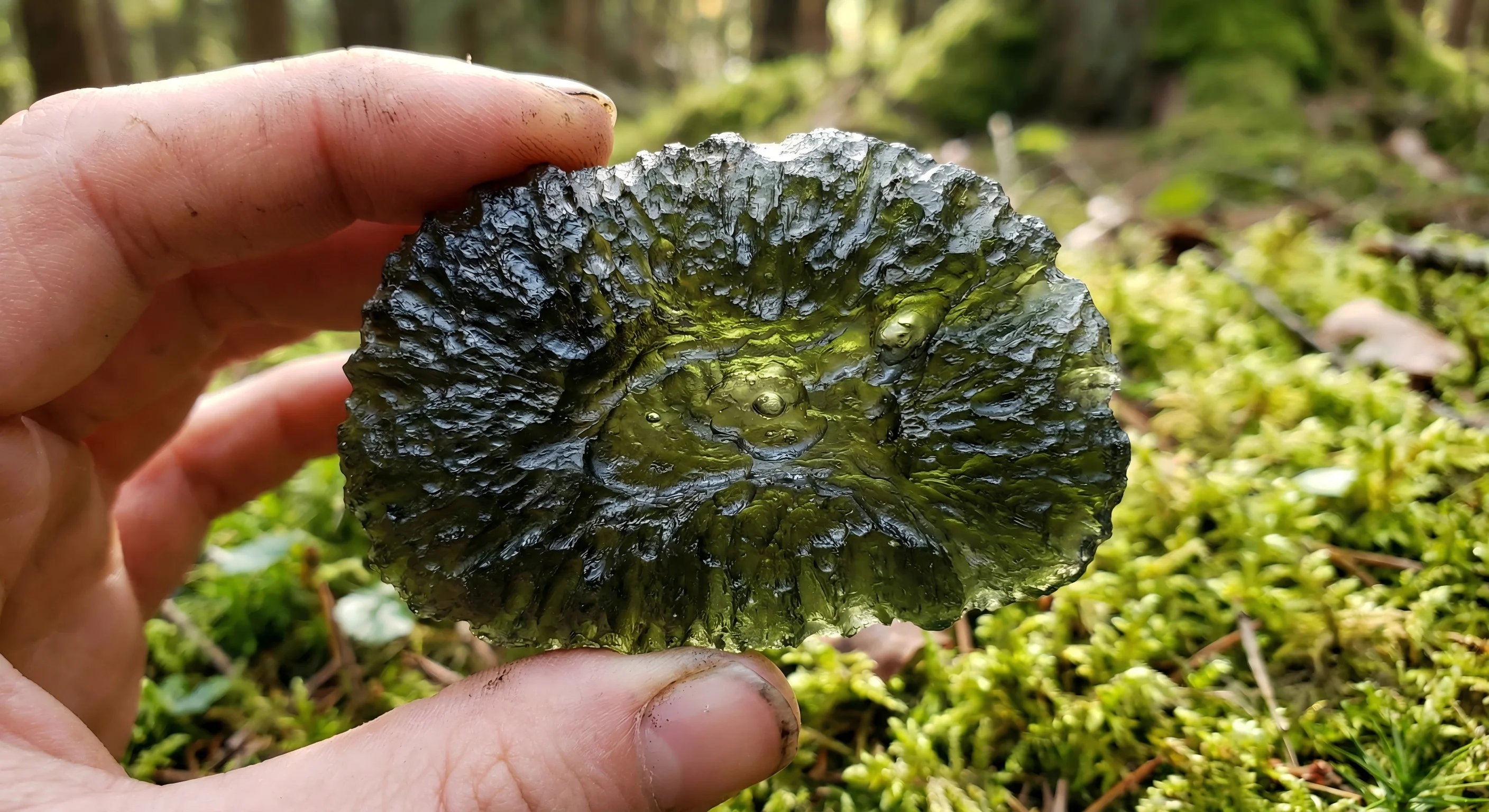
2. Flight Dynamics Laboratory

Once ejected, the molten glass entered a violent phase of atmospheric flight. It wasn't merely falling; it was spinning, cooling, and being torn apart by drag. Use the centrifuge tool to visualize how rotational velocity dictates the final morphology of the tektite.

0 (Static) Stationary Max Spin

Phase 1: Sphere / Discoidal

Low rotation allows surface tension to maintain a roughly spherical or flattened "pancake" shape.

Phase 2: Dumbbell

Centrifugal force stretches the mass outward. The "waist" begins to thin.

Phase 3: Teardrop (Breakage)

Structural failure. The connecting neck snaps, creating two separate aerodynamic teardrops.

Sim: Viscosity/Drag

The Vacuum Bubble Phenomenon

One question typically puzzles students of meteoritics: How does the glass remain so clear and devoid of water? The answer lies in the "vacuum bubble" created by the plume. As the impactor struck, it vaporized rock so quickly that it pushed the atmosphere aside, creating a momentary vacuum tunnel extending into space.

The molten silica was ejected into this vacuum. Without air resistance in the initial phase, the melt could travel vast distances—some landing over 400 kilometers away in Moravia. More importantly, this vacuum environment meant there were no volatiles (like water vapor) to be trapped in the cooling glass. This is why Moldavite is technically a "dry" glass, distinguishing it from volcanic obsidian which often contains significantly higher water content.

As the material re-entered the denser atmosphere, aerodynamics took over. Observing the centrifuge model reveals the battle between surface tension (trying to keep the blob spherical) and centrifugal force (trying to tear it apart). The "dumbbell" shapes are essentially frozen moments of this struggle. In field samples, we often find the broken ends of dumbbells—what we call "teardrops"—indicating the glass solidified just as the rotational forces overcame the material's viscosity.

3. Stratigraphic Context

Finding a tektite is an exercise in reading the soil. They are not distributed randomly but are locked within specific geological horizons representing the Miocene surface. The interactive core below visualizes the sediment layers researchers typically encounter in the Bohemian and Moravian strewn fields.

Holocene (Recent)
0 - 0.01 Ma
Pleistocene
0.01 - 2.58 Ma
Miocene (Sediment Layer)
14.8 Ma Horizon
Crystalline Basement
⛏️

Select a geological layer to analyze core sample.

Deciphering the Deposition Layers

When conducting field analysis, the transition between layers offers tactile clues. The Pleistocene layers are often characterized by rusty, gravel-heavy soils—remnants of river transport during the Ice Ages. Tektites found here are known as "alluvial" or secondary deposits. They have been moved by water, tumbling against quartz pebbles for millennia. Consequently, they lose their primary sculpting, appearing matte and rounded.

The prize for any geological survey is the undisturbed Miocene clay. This layer, often greenish or gray and dense to the touch, represents the original landing site. Field analysis of core samples from localities like Nesmen or Chlum typically shows that tektites in this layer retain their delicate surface features. The "Besednice" type, famous for its hedgehog-like spikes, owes its texture to the specific acidity of the groundwater in that locality etching the glass over millions of years. It is a process of chemical erosion that requires the specimen to remain stationary in the clay; any movement would snap the fragile spikes.

Dating these layers relies heavily on Argon-Argon (Ar-Ar) dating. By measuring the ratio of radiogenic Argon-40 to Argon-39 in the glass, geochronologists have pinned the formation age to 14.81 ± 0.05 Ma. This precise dating was the final piece of evidence linking the Bohemian tektites directly to the Ries crater, matching the age of the suevite impact melt found in Germany.

4. Micro-Structural Analysis

To the naked eye, a piece of green glass is just that—green glass. But under magnification, the chaotic history of its formation is revealed. Comparative petrography allows us to distinguish true impactites from anthropogenic (man-made) imitations by observing inclusions that defy standard melting temperatures.

Sample A: Impactite (14.8 Ma)

High Velocity Melt
Observation: Note the chaotic "Schlieren" (flow lines) and the wire-like Lechatelierite inclusions. Bubbles are elongated due to flight velocity.

Sample B: Anthropogenic Glass

Low Velocity Melt
Observation: Material is homogenous. Flow lines are absent or uniform. Bubbles are perfectly spherical due to static cooling conditions.

The Lechatelierite Marker

When we examine samples under 10x magnification or higher, the most striking feature of a natural tektite is the presence of Lechatelierite. These appear as twisted, wire-like inclusions within the glass matrix. Chemically, they are pure silica (SiO₂). Their presence is diagnostic because pure quartz sand requires temperatures exceeding 1713°C to melt.

In a standard glass furnace, the mix is kept at a lower temperature and stirred to ensure homogeneity. The "wires" of quartz would eventually dissolve into the surrounding melt. However, the Ries event was instantaneous. The temperature spike was so extreme and brief that grains of quartz sand were melted instantly but didn't have time to fully mix with the surrounding molten rock before the whole mass was ejected and cooled.

Alongside Lechatelierite, the "Schlieren" or flow lines tell a story of viscosity. Under immersion oil, these lines become visible as swirls of varying refractive index. They represent the chaotic mixing of different rock types—sand, clay, and limestone—in the microseconds following impact. Anthropogenic glass, by contrast, strives for perfection. It is uniform, clear, and predictable. The imperfections in Moldavite are, in fact, the proof of its cataclysmic birth.

AUTH_SIG_VERIFIED
ENCRYPTION_ACTIVE

Investigator Profile

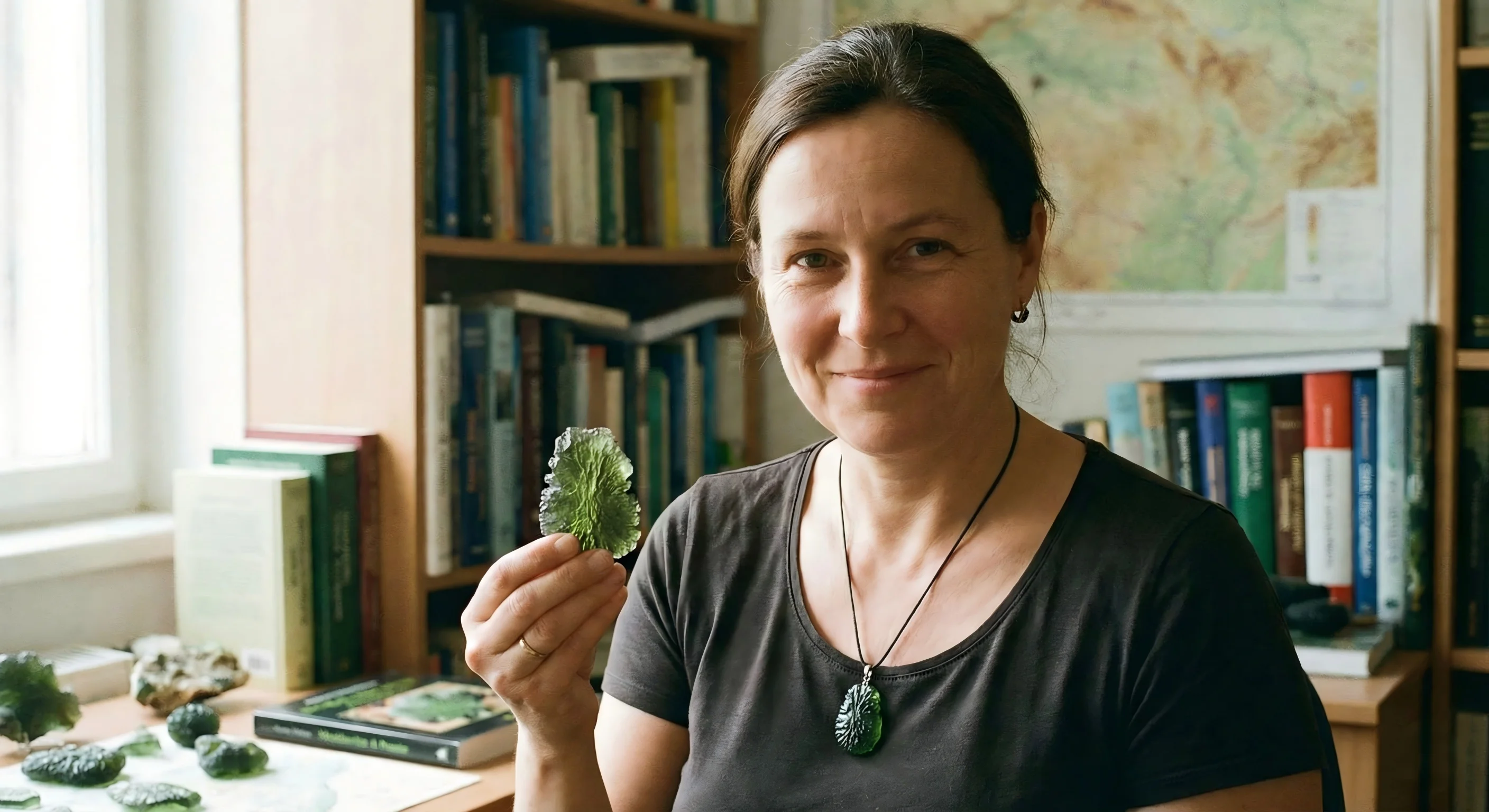
Hi, I’m Emily Carter, a long-time crystal researcher and writer with a special focus on Moldavite and high-vibration tektites. For over a decade, I’ve studied the geological origins and spiritual interpretations of rare stones, combining scientific literature with mindful, experience-based insight. This blog is where I share what Moldavite has taught me about transformation, awareness, and inner alignment.

Moldavite enthusiasts
Access Full moldavite geology origins Database